URWERK Uses Light Travel to Make Cosmic Time Legible
The URWERK UR-100V Lightspeed Ceramic combines the established satellite-hour platform with a scale for sunlight’s journey through the solar system. Its layered white composite case and planetary markers turn material engineering and scientific narrative into one instrument.
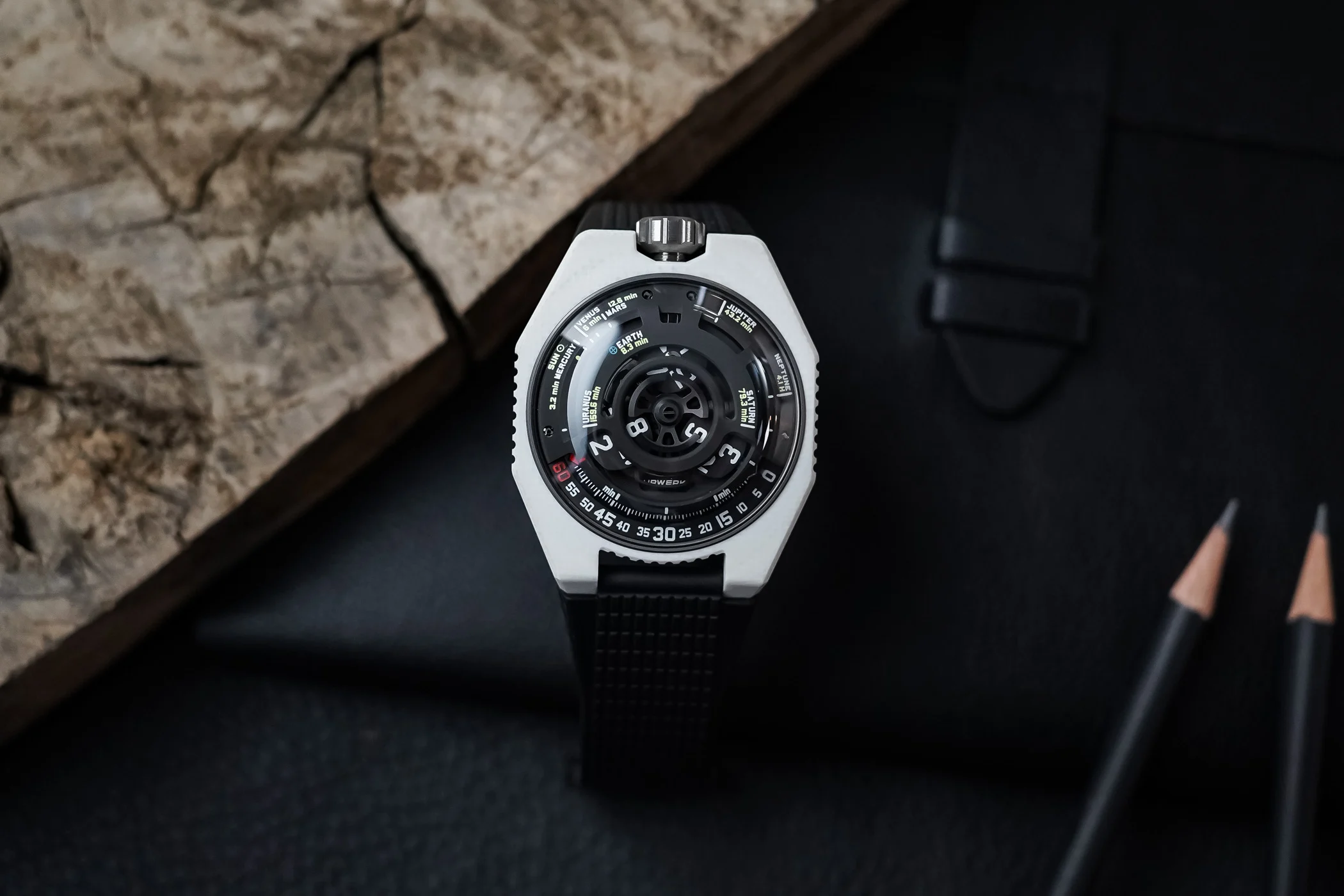
In brief. The Lightspeed Ceramic is more than a white-case variant because its reinforced composite and planetary light-time scale reinterpret the established UR-100 platform through both material engineering and scientific storytelling.[1] [2] [3] [4] [5] [6] [7] [8]
The UR-100 Platform Before Lightspeed
The UR-100 series debuted in 2019 with URWERK’s wandering-hour satellite display. The Lightspeed Ceramic case measures 43 mm wide, 51.7 mm long and 14.55 mm thick.[1] [2]
The UR-100 series supplies the known mechanical foundation: wandering-hour satellites inside a comparatively compact URWERK format. Lightspeed does not discard that platform. It uses the existing display as a carrier for a different scale, allowing the new narrative to remain legible as part of the family.[1] [2]
Why the White Case Is Not Conventional Ceramic
Its white composite combines ceramic with glass and carbon-fibre layers in a polymer matrix. Three rotating hour satellites cross a 120-degree minute arc.[3] [4]
The white case is described as a composite of ceramic, glass and carbon-fibre layers in a polymer matrix. That construction matters because it is not conventional monolithic ceramic. The material claim should be assessed on its documented composition, while impact behaviour remains untested by independent evidence here.[3] [4]
Reading a Photon’s Journey Around the Dial
The display marks sunlight reaching Earth after 8.3 minutes and Neptune after more than four hours. The Vaucher-developed UR-12.02 runs at 28,800 vibrations per hour and offers 48 hours of reserve.[5] [6]
The planetary scale reframes elapsed time at an astronomical magnitude. Earth is reached after 8.3 minutes, while Neptune requires more than four hours. These markers do not improve civil timekeeping; they make an otherwise abstract scientific relationship readable around a mechanical display.[5] [6]
Three Satellites and the UR-12.02 Calibre
A Windfanger air turbine limits rotor speed to reduce wear. The reviewed watch is priced at CHF 67,000 before taxes.[7] [8]
Three hour satellites cross a 120-degree minute arc, driven by the Vaucher-developed UR-12.02. Its 28,800 vibrations per hour and 48-hour reserve define the base performance. The Windfanger turbine manages rotor speed, adding a protective function to the automatic winding architecture.[7] [8]
A CHF 67,000 Poetic Instrument
The UR-100 series debuted in 2019 with URWERK’s wandering-hour satellite display. The Lightspeed Ceramic case measures 43 mm wide, 51.7 mm long and 14.55 mm thick.[1] [2]
At CHF 67,000 before taxes, the watch is priced as a rare expressive instrument, not a practical route to astronomical data. Its case size and poetic scale demand commitment. The sources document construction and concept, but not independent impact, chronometric or long-term service performance.[1] [2]
The Dial Brief view
Collectors get a clear example of poetic complication design supported by a new case material and a mature wandering-hour platform. The UR-100 series supplies the known mechanical foundation: wandering-hour satellites inside a comparatively compact URWERK format. Lightspeed does not discard that platform. It uses the existing display as a carrier for a different scale, allowing the new narrative to remain legible as part of the family. The white case is described as a composite of ceramic, glass and carbon-fibre layers in a polymer matrix. That construction matters because it is not conventional monolithic ceramic. The material claim should be assessed on its documented composition, while impact behaviour remains untested by independent evidence here. The planetary scale reframes elapsed time at an astronomical magnitude. Earth is reached after 8.3 minutes, while Neptune requires more than four hours. These markers do not improve civil timekeeping; they make an otherwise abstract scientific relationship readable around a mechanical display. Three hour satellites cross a 120-degree minute arc, driven by the Vaucher-developed UR-12.02. Its 28,800 vibrations per hour and 48-hour reserve define the base performance. The Windfanger turbine manages rotor speed, adding a protective function to the automatic winding architecture. At CHF 67,000 before taxes, the watch is priced as a rare expressive instrument, not a practical route to astronomical data. Its case size and poetic scale demand commitment. The sources document construction and concept, but not independent impact, chronometric or long-term service performance. The material performance claims come from the maker and review; there is no independent impact test, chronometric test, measured wrist mass or long-term service evidence.
What we know, and what remains unconfirmed
The material performance claims come from the maker and review; there is no independent impact test, chronometric test, measured wrist mass or long-term service evidence.