Otsuka Lotec No. 8 Turns a Mixing Console Into Time
The Otsuka Lotec No. 8 turns an analogue mixing console into a mechanical display. Jumping hours, retrograde minutes and a counterclockwise 90-second disk animate a rectangular case through a 62-component module on a Miyota base.
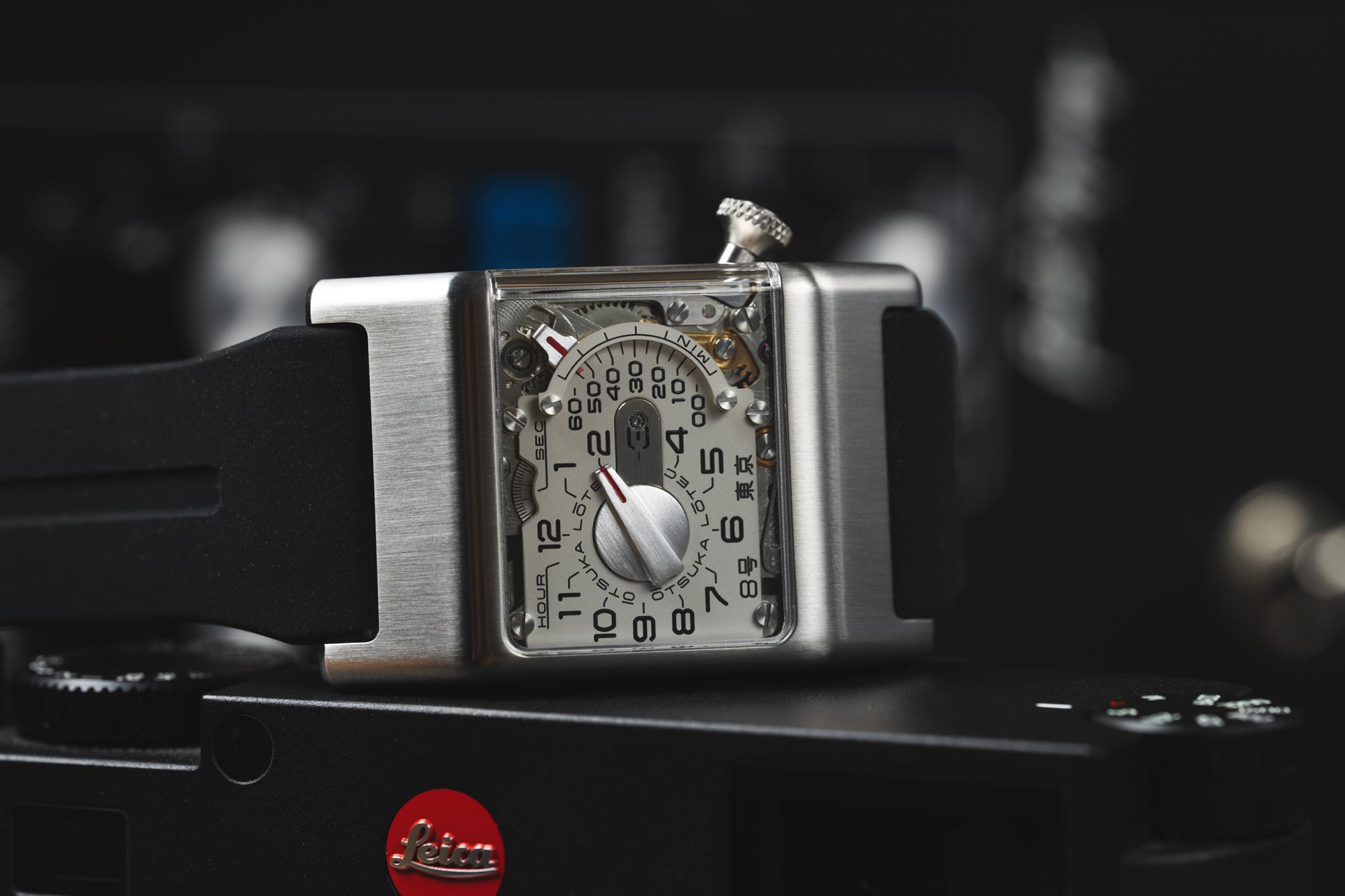
In brief. The No. 8 succeeds because its recording-console references are generated by the display module itself: the jumping selector hand, sliding minutes and flywheel are mechanisms first and visual motifs second.[1] [2] [3] [4] [5] [6] [7] [8]
From Product Design to a Tokyo Watch Workshop
The No. 8 takes inspiration from analogue mixing consoles, including equipment associated with Abbey Road Studios. Its case measures 31 mm by 47.7 mm, is 10.8 mm thick and is rated to 30 metres.[1] [2]
Jiro Katayama’s route from product design into watchmaking helps explain why the No. 8 begins with an interface. His long experimentation with cases and later sales history frame the watch as the result of a workshop language developed over time, not a single borrowed visual reference.[1] [2]
Why a Mixing Console Defines the Layout
Hours jump, minutes move on a retrograde slider and the counterclockwise seconds disk turns once every 90 seconds. A Miyota 90S5 supports an in-house-designed 62-component display module.[3] [4]
The analogue console reference determines where and how information appears. A rectangular case provides the panel, while separate indications behave like a selector, slider and rotating control. The Abbey Road association gives the inspiration specificity without claiming that the watch reproduces one console literally.[3] [4]
Jumping Hours, Sliding Minutes and Slow Seconds
Jiro Katayama engineers the modules, which are manufactured by Precision Watch Tokyo, founded by Hajime Asaoka. The display mechanisms reduce stated power reserve to 32 hours.[5] [6]
The display has three different rhythms. Hours jump, minutes travel across a retrograde slider and the seconds disk turns counterclockwise once every 90 seconds. Their coordination produces the watch’s industrial personality through motion, making the mechanics responsible for the visual identity.[5] [6]
A 62-Part Module on a Miyota Base
The listed price is JPY 990,000, approximately USD 6,200 at publication. Katayama began experimenting with watch cases around 2008 and started selling watches in 2012.[7] [8]
A Miyota 90S5 supplies the base, while a 62-component module creates the unusual indications. Katayama engineers the modules and Precision Watch Tokyo manufactures them. That division of work identifies both authorship and production, while the 32-hour reserve shows the energy cost of the display system.[7] [8]
The No. 8 as an Ownership Proposition
The No. 8 takes inspiration from analogue mixing consoles, including equipment associated with Abbey Road Studios. Its case measures 31 mm by 47.7 mm, is 10.8 mm thick and is rated to 30 metres.[1] [2]
The 31 mm by 47.7 mm case, 30-metre rating, 32-hour reserve and JPY 990,000 price define clear compromises. Originality is high, but minutes require interpretation and water resistance is modest. Short-term owner experience cannot answer long-term module reliability or laboratory timing questions.[1] [2]
The Dial Brief view
The No. 8 demonstrates that independent identity can come from display engineering and industrial design rather than traditional hand finishing. Jiro Katayama’s route from product design into watchmaking helps explain why the No. 8 begins with an interface. His long experimentation with cases and later sales history frame the watch as the result of a workshop language developed over time, not a single borrowed visual reference. The analogue console reference determines where and how information appears. A rectangular case provides the panel, while separate indications behave like a selector, slider and rotating control. The Abbey Road association gives the inspiration specificity without claiming that the watch reproduces one console literally. The display has three different rhythms. Hours jump, minutes travel across a retrograde slider and the seconds disk turns counterclockwise once every 90 seconds. Their coordination produces the watch’s industrial personality through motion, making the mechanics responsible for the visual identity. A Miyota 90S5 supplies the base, while a 62-component module creates the unusual indications. Katayama engineers the modules and Precision Watch Tokyo manufactures them. That division of work identifies both authorship and production, while the 32-hour reserve shows the energy cost of the display system. The 31 mm by 47.7 mm case, 30-metre rating, 32-hour reserve and JPY 990,000 price define clear compromises. Originality is high, but minutes require interpretation and water resistance is modest. Short-term owner experience cannot answer long-term module reliability or laboratory timing questions. The account reflects one owner’s short-term experience; water resistance is modest, minutes require estimation and no independent laboratory timing or long-term module reliability data is available.
What we know, and what remains unconfirmed
The account reflects one owner’s short-term experience; water resistance is modest, minutes require estimation and no independent laboratory timing or long-term module reliability data is available.