NOMOS Shrinks Its Ring Date Without Losing the Mechanism
The NOMOS Tangente neomatik 38 Update fits the brand’s peripheral date display into a 38.5 mm by 7.4 mm case. A revised barrel-spring alloy lifts the DUW 6101 to about 50 hours while preserving the calibre’s established architecture.
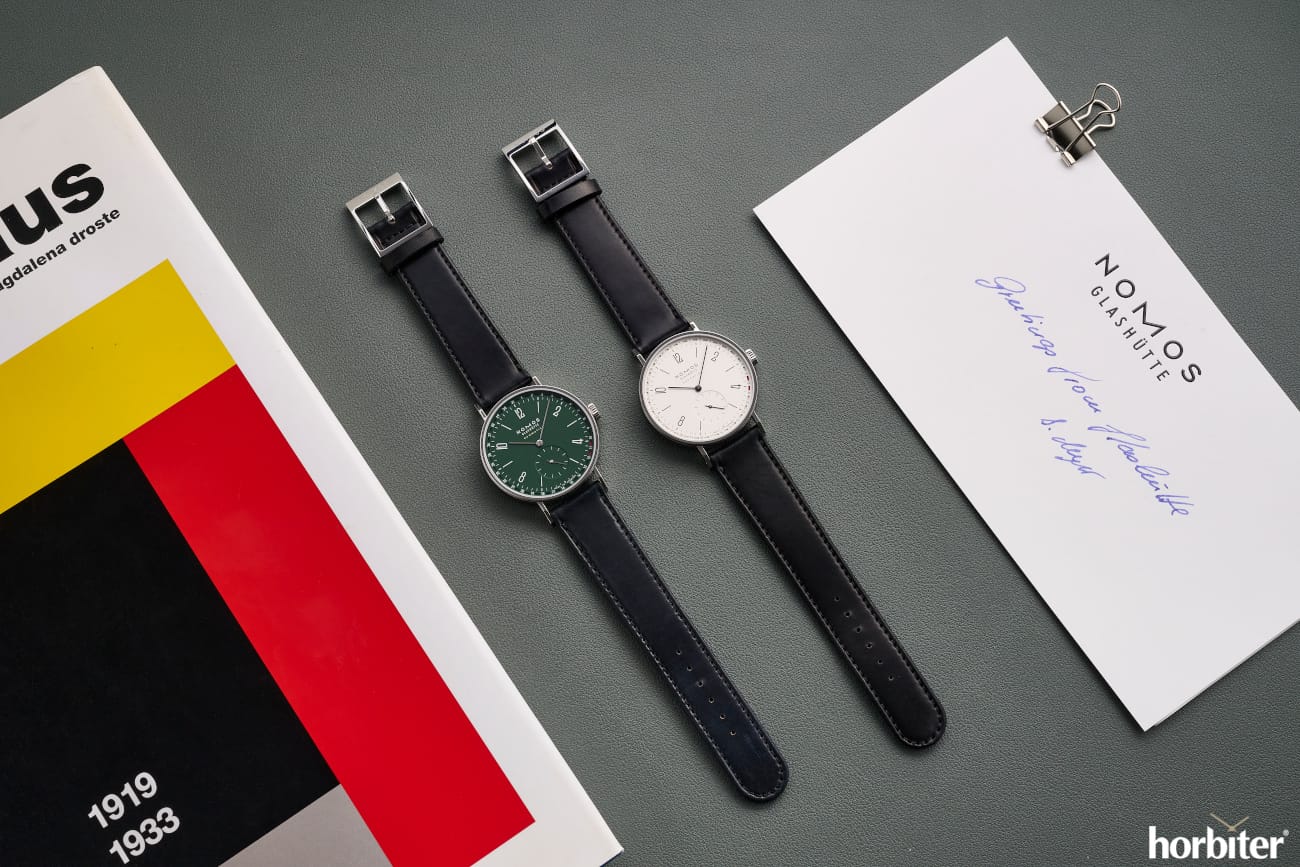
In brief. The smaller Tangente Update matters because NOMOS preserved the bidirectional peripheral date and slim proportions while extracting more reserve from the same calibre architecture, making packaging the real technical story.[1] [2] [3] [4] [5] [6] [7] [8]
A Smaller Home for the Update Date
The reviewed Tangente neomatik 38 Update measures 38.5 mm by 7.4 mm. Its peripheral date uses fixed numerals and a moving coloured ring beneath the dial.[1] [2]
The smaller case changes the proposition without changing what makes the Update recognisable. At 38.5 mm and 7.4 mm thick, the watch gives the peripheral date a more compact frame. The fixed numerals and moving coloured ring retain the original display logic within that reduced package.[1] [2]
How the Peripheral Ring Shows the Date
The date can be corrected quickly in either direction. The automatic DUW 6101 runs at 4 Hz and now provides about 50 hours of reserve.[3] [4]
The ring date separates scale from marker. Numerals remain fixed while colour moves beneath the dial, so the date can be read at the perimeter without adding a conventional window. Bidirectional quick correction makes that graphic solution practical when the calendar needs adjustment.[3] [4]
Eight More Hours From the DUW 6101
The revised barrel-spring alloy adds roughly eight hours without changing the basic calibre architecture. The steel versions include silver-plated and forest-green dials.[5] [6]
An increase of roughly eight hours is modest enough to describe honestly and useful enough to matter between wears. The revised spring alloy changes energy storage rather than the basic calibre layout. At 4 Hz and about 50 hours, the improvement is evolutionary, not a new movement disguised by naming.[5] [6]
Silver and Forest Green in Steel
Water resistance is rated to 5 atm. Italian pricing is listed at EUR 3,680 for silver and EUR 3,760 for forest green.[7] [8]
Silver-plated and forest-green dials apply different colour relationships to the same steel architecture. The distinction is confirmed, while broader availability is not. Italian prices establish a market reference for each version but should not be read as a universal schedule or price for every region.[7] [8]
Thickness, Water Resistance and Pricing
The reviewed Tangente neomatik 38 Update measures 38.5 mm by 7.4 mm. Its peripheral date uses fixed numerals and a moving coloured ring beneath the dial.[1] [2]
The practical contract combines a notably thin case, a peripheral date, 5 atm resistance and mid-four-figure euro pricing. Those facts make packaging the central technical achievement. They do not establish rate performance, service intervals or long-term reliability, which remain outside the available evidence.[1] [2]
The Dial Brief view
Collectors can see how a mature in-house calibre is improved through packaging and energy storage rather than a wholly new complication. The smaller case changes the proposition without changing what makes the Update recognisable. At 38.5 mm and 7.4 mm thick, the watch gives the peripheral date a more compact frame. The fixed numerals and moving coloured ring retain the original display logic within that reduced package. The ring date separates scale from marker. Numerals remain fixed while colour moves beneath the dial, so the date can be read at the perimeter without adding a conventional window. Bidirectional quick correction makes that graphic solution practical when the calendar needs adjustment. An increase of roughly eight hours is modest enough to describe honestly and useful enough to matter between wears. The revised spring alloy changes energy storage rather than the basic calibre layout. At 4 Hz and about 50 hours, the improvement is evolutionary, not a new movement disguised by naming. Silver-plated and forest-green dials apply different colour relationships to the same steel architecture. The distinction is confirmed, while broader availability is not. Italian prices establish a market reference for each version but should not be read as a universal schedule or price for every region. The practical contract combines a notably thin case, a peripheral date, 5 atm resistance and mid-four-figure euro pricing. Those facts make packaging the central technical achievement. They do not establish rate performance, service intervals or long-term reliability, which remain outside the available evidence. The Italian review supplies observations and specifications, but the sources do not include independent rate results, a full reference-by-reference availability schedule or long-term service data.
What we know, and what remains unconfirmed
The Italian review supplies observations and specifications, but the sources do not include independent rate results, a full reference-by-reference availability schedule or long-term service data.