Armin Strom Makes the Date a Mechanical Performance
The Armin Strom Orbit Midnight Purple moves the date to the bezel, sends its hand away at the press of a pusher and mechanically remembers the correct date until it returns. Its display, equal-force calibre and dial-side architecture make the interaction more important than the new colour.
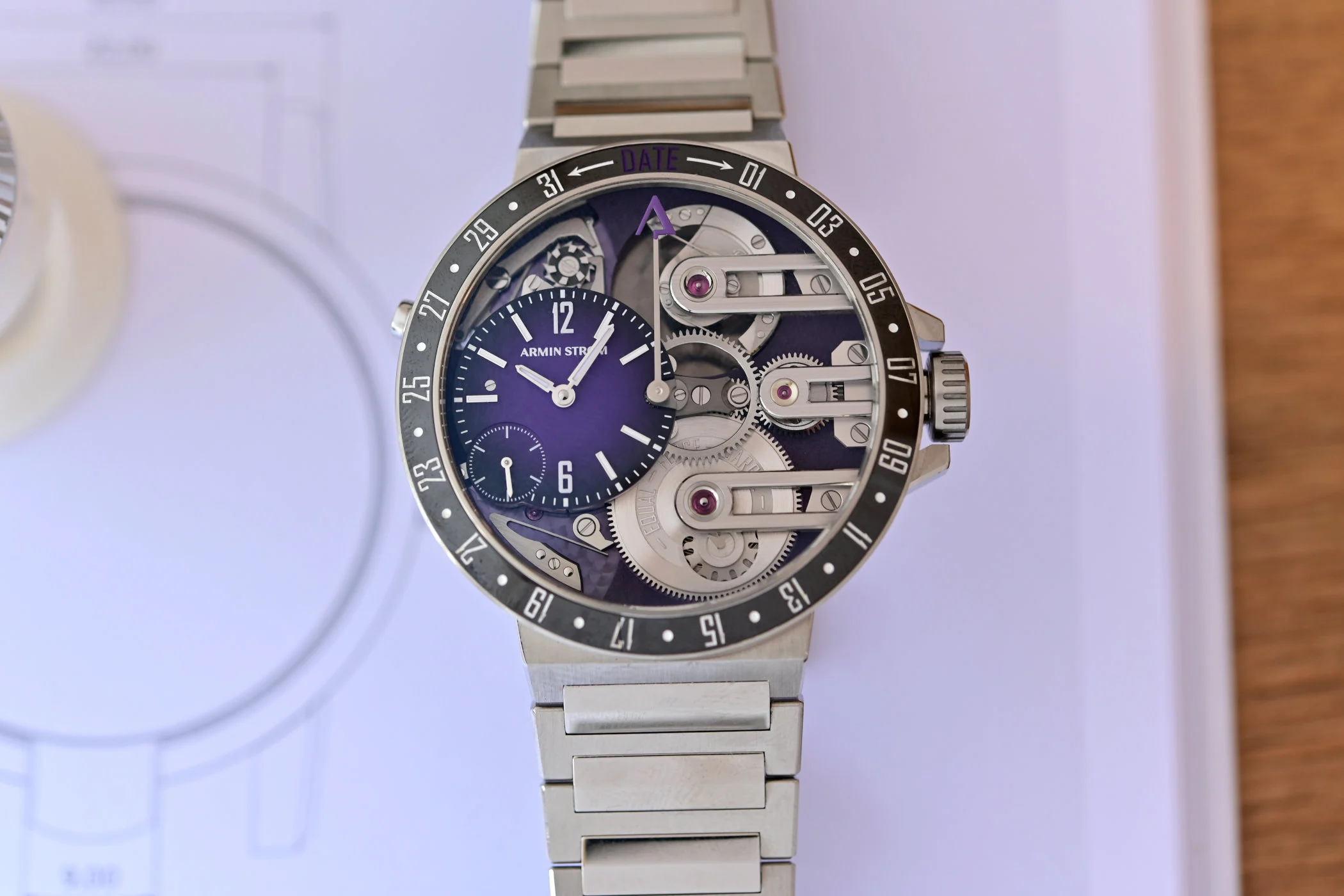
In brief. The Orbit earns attention not from its new colour but from treating the date as a reversible mechanical performance: its bezel scale, column wheel, memory system and exposed equal-force calibre all serve one coherent interaction.[1] [2] [3] [4] [5] [6] [7] [8]
Why the Date Had to Leave the Dial
The Orbit first appeared in 2022 with its date scale engraved on the bezel. A pusher at 10 o’clock sends the date hand to the correct date or returns it to noon.[1] [2]
Moving the date away from the hours and minutes is an architectural decision, not a decorative relocation. The off-centre display keeps ordinary time compact while the bezel becomes an active scale. Parking the date hand then restores an uncluttered reading whenever the owner prefers it.[1] [2]
Because the date scale occupies the bezel, its hand crosses a part of the watch normally reserved for framing. The pusher matters as much as the scale: it lets the owner choose between a complete calendar display and a cleaner view of the off-centre time dial.[1] [2]
How the On-Demand Date Remembers
A mechanical memory wheel continues tracking the date while the hand is parked. The steel case measures 43.4 mm by 12.6 mm and is rated to 50 metres.[3] [4]
The memory wheel is the crucial distinction between hiding information and stopping it. The visible hand can return to noon while the underlying mechanism continues its calendar task. When called back, the date is therefore presented as a controlled mechanical event rather than a manually reconstructed indication.[3] [4]
The 43.4 mm case gives the mechanism room, but its 50-metre rating keeps the watch outside any serious sports brief. The appeal is interaction: the hand can leave the display while the memory wheel preserves information that would otherwise need to be reset.[3] [4]
The Equal-Force Calibre Behind the Display
The automatic ASS20 calibre uses an equal-force barrel and provides 72 hours of reserve. Midnight Purple extends from the gradient sub-dial to the frosted mainplate and date-hand tip.[5] [6]
The equal-force barrel connects the display to the movement instead of leaving the complication as a module with no visual argument. A 72-hour reserve supports the watch between interactions, while the dial-side exposure makes the path from stored energy to displayed information part of the experience.[5] [6]
The ASS20 therefore has two jobs to make visible. It regulates delivery from the barrel and carries the date mechanism on the dial side. That relationship is stronger than a decorative openworked view because the exposed components explain what the owner can operate.[5] [6]
When Colour Reaches the Mainplate
The edition is limited to 20 pieces and priced at CHF 36,000. Armin Strom operates an integrated manufacture in Biel and exposes much of the movement on the dial side.[7] [8]
Purple is meaningful here because it reaches beyond the sub-dial. Extending the treatment to the frosted mainplate and hand tip binds colour to layers that reveal the calibre. The result can be judged as a coordinated architecture rather than a familiar watch with a different surface accent.[7] [8]
At CHF 36,000 and 20 pieces, this is a narrow proposition even within independent watchmaking. The integrated Biel manufacture makes the colour treatment more credible as part of the movement architecture, but scarcity and price do not prove finishing consistency on their own.[7] [8]
Size, Water Resistance and the 20-Piece Limit
The Orbit first appeared in 2022 with its date scale engraved on the bezel. A pusher at 10 o’clock sends the date hand to the correct date or returns it to noon.[1] [2]
The case dimensions, water rating, price and 20-piece limit define a narrow ownership contract. This is a large, costly and scarce independent watch whose value rests on the coherence of one unusual date interaction. The available evidence supports the mechanism, not assumptions about durability or service.[1] [2]
The Orbit is easiest to judge as one complete system: large case, moderate water resistance, 72-hour reserve and an on-demand date. None of those figures alone justifies the price. The case depends on whether the unusual interaction remains satisfying after the novelty fades.[1] [2]
The Dial Brief view
Collectors get a rare case in which a familiar complication changes the architecture and interaction of the entire watch. Moving the date away from the hours and minutes is an architectural decision, not a decorative relocation. The off-centre display keeps ordinary time compact while the bezel becomes an active scale. Parking the date hand then restores an uncluttered reading whenever the owner prefers it. The memory wheel is the crucial distinction between hiding information and stopping it. The visible hand can return to noon while the underlying mechanism continues its calendar task. When called back, the date is therefore presented as a controlled mechanical event rather than a manually reconstructed indication. The equal-force barrel connects the display to the movement instead of leaving the complication as a module with no visual argument. A 72-hour reserve supports the watch between interactions, while the dial-side exposure makes the path from stored energy to displayed information part of the experience. Purple is meaningful here because it reaches beyond the sub-dial. Extending the treatment to the frosted mainplate and hand tip binds colour to layers that reveal the calibre. The result can be judged as a coordinated architecture rather than a familiar watch with a different surface accent. The case dimensions, water rating, price and 20-piece limit define a narrow ownership contract. This is a large, costly and scarce independent watch whose value rests on the coherence of one unusual date interaction. The available evidence supports the mechanism, not assumptions about durability or service. The available sources do not provide independent rate testing, long-term bracelet experience, measured impact resistance or service pricing.
What we know, and what remains unconfirmed
The available sources do not provide independent rate testing, long-term bracelet experience, measured impact resistance or service pricing.