Bernhardt Gives the American Microbrand Dress Watch Real Proportion
The Bernhardt Captain is a compact automatic dress watch offered as Fog, Cove and Cypress. Its 38 mm proportions, sapphire crystal, 50-metre rating and United States assembly and regulation make restraint, rather than novelty, the centre of the proposition.
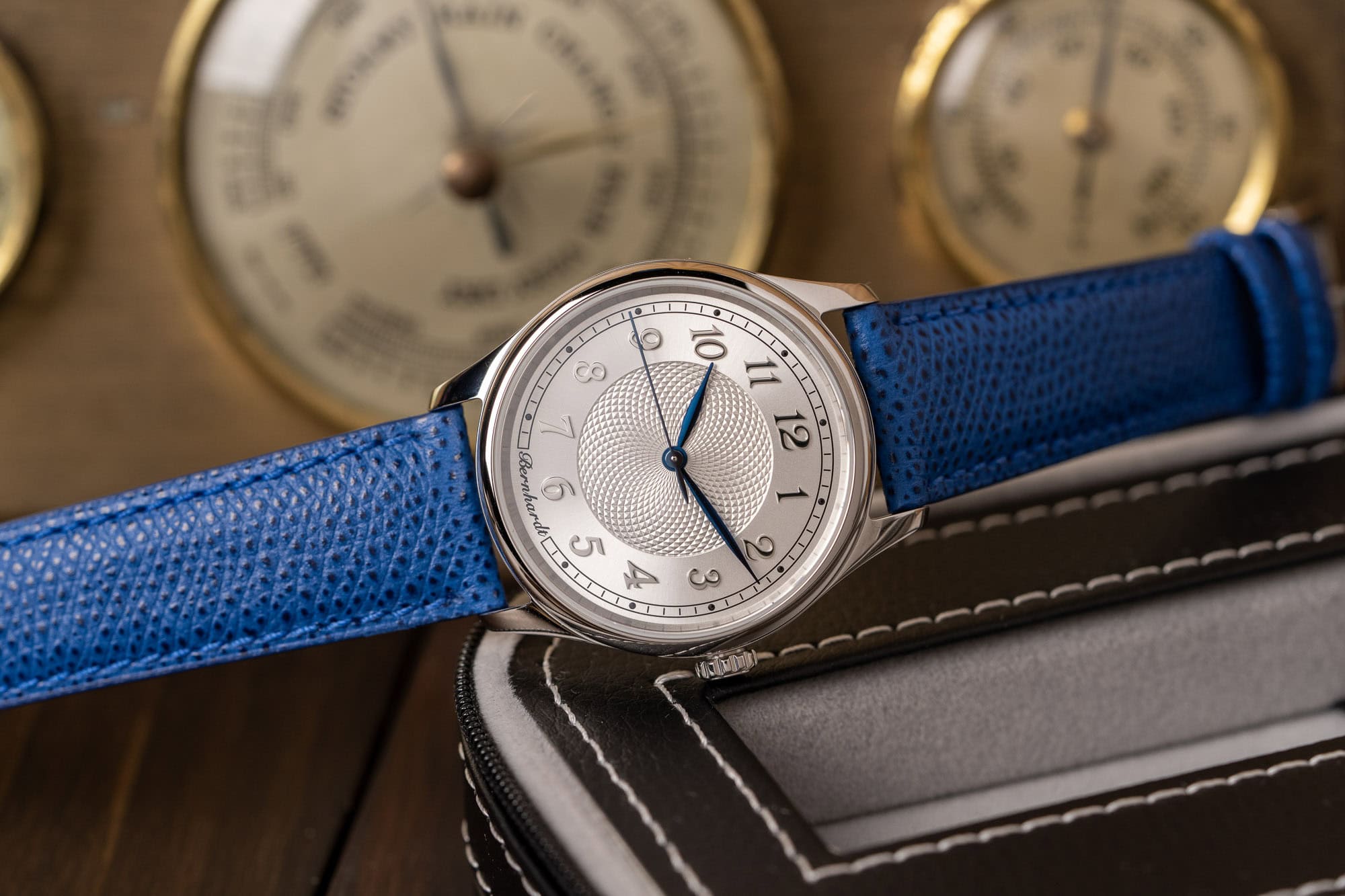
In brief. The Captain is persuasive because Bernhardt treats proportion and domestic regulation as the product, using a compact case and three controlled dial treatments instead of inflating a simple dress-watch formula.[1] [2] [3] [4] [5] [6] [7] [8]
Where the Captain Fits in Bernhardt’s Range
The Captain launches as Fog, Cove and Cypress references. Each version uses a 38 mm case with a 45 mm lug-to-lug span and 9.55 mm thickness.[1] [2]
The collection is best understood as a move toward formal proportion from a maker associated with practical watches. A 38 mm diameter, short lug span and slim case establish that shift directly. The three references then vary expression without changing the underlying size or purpose.[1] [2]
Three Dials, One Controlled Design
The watches use sapphire crystals and are rated to 50 metres. A Miyota 9039 automatic calibre powers the collection.[3] [4]
Fog, Cove and Cypress do not ask three unrelated design questions. Guilloche, blue treatment and green with rose-gold-tone PVD create distinct moods inside a shared format. Applied numerals and the dress brief hold the family together while allowing colour and surface to carry the differentiation.[3] [4]
The 38 mm Case Is the Main Decision
Fog has a silver guilloche dial and heat-treated blue hands, while Cove is blue and Cypress uses green with rose-gold-tone PVD. Applied numerals and a US-made leather strap support the dress-watch brief.[5] [6]
Diameter alone can disguise how a watch will occupy the wrist, so the 45 mm lug span and 9.55 mm thickness matter. Together they describe a compact object intended to clear a cuff. Sapphire and 50 metres of resistance add everyday utility without recasting it as a sports watch.[5] [6]
Miyota Mechanics With American Regulation
Each Captain is listed at USD 749. Bernhardt states that design, assembly and regulation are performed in the United States.[7] [8]
The Miyota 9039 establishes the Japanese mechanical base, while Bernhardt states that design, assembly and regulation take place in the United States. Keeping those roles separate is important. Local work adds a maker-specific contribution without turning the underlying calibre into an American movement.[7] [8]
What $749 Buys and What Remains Untested
The Captain launches as Fog, Cove and Cypress references. Each version uses a 38 mm case with a 45 mm lug-to-lug span and 9.55 mm thickness.[1] [2]
At USD 749, the case, dial variants, sapphire, strap and stated domestic work form the documented value package. The unresolved question is performance across delivered watches. Without independent timing, durability or service evidence, regulation should be treated as a process claim rather than a measured guarantee.[1] [2]
The Dial Brief view
The launch shows how an established American microbrand can compete through proportion, regulation and local assembly instead of novelty. The collection is best understood as a move toward formal proportion from a maker associated with practical watches. A 38 mm diameter, short lug span and slim case establish that shift directly. The three references then vary expression without changing the underlying size or purpose. Fog, Cove and Cypress do not ask three unrelated design questions. Guilloche, blue treatment and green with rose-gold-tone PVD create distinct moods inside a shared format. Applied numerals and the dress brief hold the family together while allowing colour and surface to carry the differentiation. Diameter alone can disguise how a watch will occupy the wrist, so the 45 mm lug span and 9.55 mm thickness matter. Together they describe a compact object intended to clear a cuff. Sapphire and 50 metres of resistance add everyday utility without recasting it as a sports watch. The Miyota 9039 establishes the Japanese mechanical base, while Bernhardt states that design, assembly and regulation take place in the United States. Keeping those roles separate is important. Local work adds a maker-specific contribution without turning the underlying calibre into an American movement. At USD 749, the case, dial variants, sapphire, strap and stated domestic work form the documented value package. The unresolved question is performance across delivered watches. Without independent timing, durability or service evidence, regulation should be treated as a process claim rather than a measured guarantee. The sources do not provide independent timing data across multiple examples, long-term wear, service intervals or production quantities.
What we know, and what remains unconfirmed
The sources do not provide independent timing data across multiple examples, long-term wear, service intervals or production quantities.