U-Boat Turns an Oil-Filled Instrument Into Deliberate Tool Art
The U-Boat U-65 TEK is an oil-filled 44 mm quartz watch that turns the visual language of pressure instruments into a deliberately theatrical object. Its circuit-board dial, visible bubble and crownless setting system explain the appeal more clearly than its 50-metre water-resistance rating does.
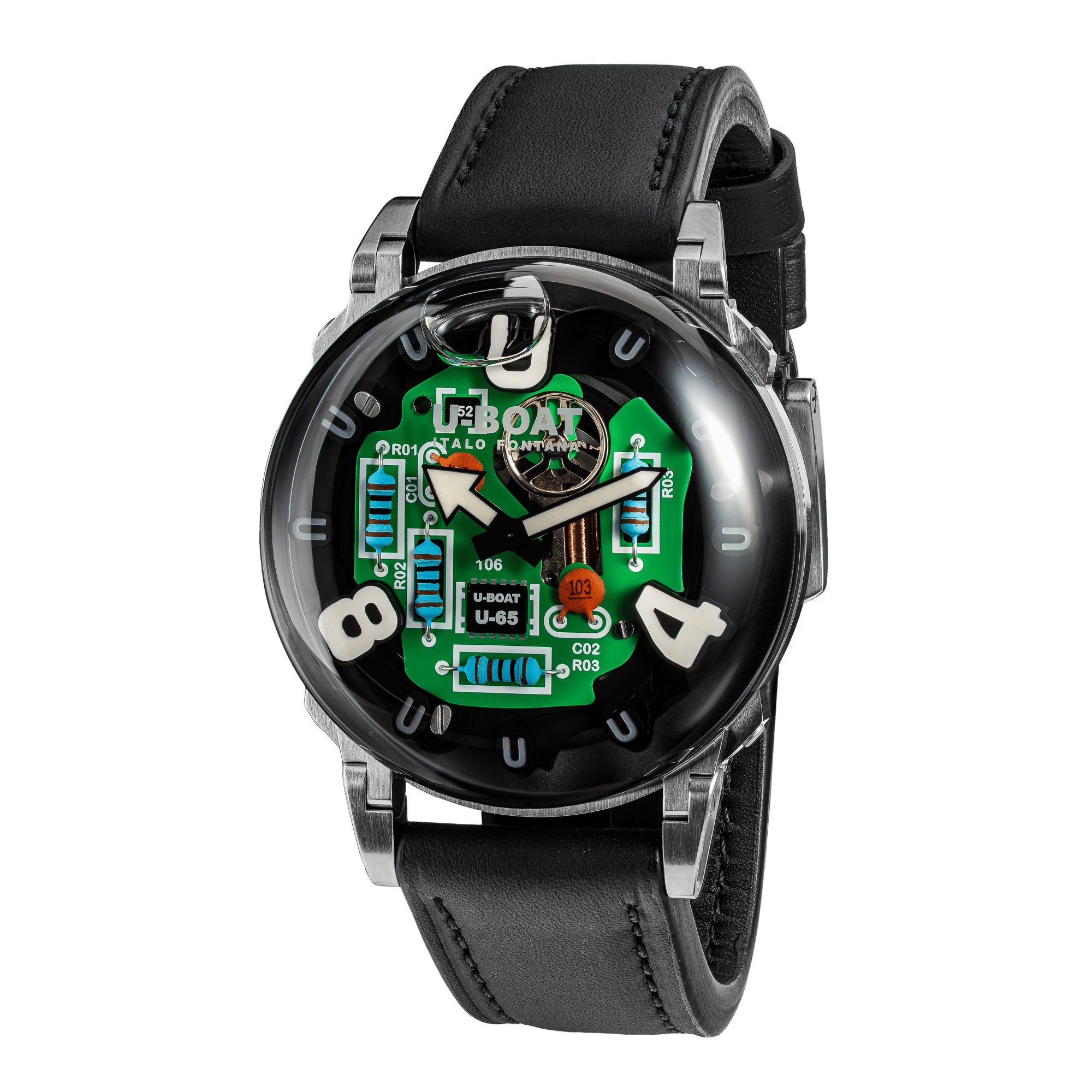
In brief. The U-65 TEK is most coherent when read as tool art rather than a dive watch: oil improves the dial effect and recalls pressure instruments, while the bubble, circuit-board motif and crownless setting system turn engineering cues into spectacle.[1] [2] [3] [4] [5] [6] [7] [8]
Where the Oil-Filled Instrument Reference Begins
The U-65 TEK SS reference 3364 uses a 44 mm stainless-steel case filled with a special oil. The oil creates an apparent absence-of-glass effect and improves dial contrast, while a visible air bubble compensates for temperature-driven volume changes. Water resistance is 50 metres, which limits the case for interpreting it as a serious dive instrument.[1] [2] [7]
The oil is not a decorative liquid added without consequence. It changes the optical relationship between the dial and the crystal, making the display appear closer to the surface and increasing contrast. The compensating bubble is therefore part of the system as well as part of the spectacle. What the architecture does not supply is proof of professional underwater capability, because the stated depth rating remains modest.[1] [2] [7]
That distinction helps place the watch accurately. Liquid-filled pressure instruments provide the reference, but a wristwatch can borrow their cues without inheriting their certified use. Here the strongest documented benefit is visual, supported by the physical role of the bubble. A collector should read the U-65 TEK as an instrument-inspired design whose actual operating envelope is defined by the published 50-metre rating.[1] [2] [7]
A Circuit Board Used as Visual Language
A decorative vintage-style circuit board occupies the dial centre, with a cut-away exposing the quartz oscillator coil. The watch uses a Swiss Ronda 756 quartz movement for hours and minutes.[3] [4]
The circuit board is best understood as graphic architecture. It supplies tracks, components and an electronic vocabulary across the dial, while the cut-away points toward the real oscillator below. This is a useful piece of honesty: the decoration does not pretend to be the entire working movement, yet it directs attention to the quartz technology that actually keeps time.[3] [4]
Legibility depends on that hierarchy. The circuit pattern creates density at the centre, but the two-hand display remains the primary reading layer. The design succeeds when the board is seen as visual language rather than as a claim of complicated electronics. That makes the exposed coil important, because it connects the decorative motif to one authentic element of the Ronda calibre without confusing the two.[3] [4]
Why the Watch Has No Crown
The watch uses a Swiss Ronda 756 quartz movement for hours and minutes. Time is adjusted through an inset caseback pusher rather than a crown.[4] [5]
Removing the crown makes the case profile feel more like a sealed instrument, but it also changes a basic ownership interaction. The wearer uses an inset pusher on the back to advance the hands. That arrangement is sensible for a two-hand quartz watch because setting should be infrequent, although it is less immediate than turning a conventional crown and may require a small tool.[4] [5]
The Ronda 756 keeps the functional proposition deliberately narrow: hours and minutes, driven by a widely identified Swiss quartz movement. There is no mechanical winding ritual or seconds display to dominate attention. Instead, the unusual setting method and the exposed oscillator become the points of interaction. Buyers should decide whether that trade feels elegantly integrated or merely inconvenient before assigning value to the crownless construction.[4] [5]
A Large Case Designed Around the Crystal
The oil creates an apparent absence-of-glass effect and improves dial contrast, while a visible air bubble compensates for temperature-driven volume changes. The domed sapphire crystal contributes to an overall thickness of about 18 mm, and articulated lugs reduce the effective span.[2] [6]
A 44 mm diameter is only one part of the wearing story. The domed crystal lifts total thickness to roughly 18 mm, giving the watch substantial vertical presence, while articulated lugs are intended to reduce the effective span across the wrist. Those lugs can help the strap turn downward sooner, but they cannot make the crystal or visual mass disappear.[2] [6]
The crystal is also where the optical idea becomes most visible. Oil, sapphire and the moving bubble create an apparent continuity between dial and exterior surface. This makes thickness part of the design rather than an accidental specification. Prospective owners still need to assess cuff clearance, balance and strap articulation in person, because the sources provide dimensions and construction details but no universal comfort result.[2] [6]
The Collector Contract Is Tool Art, Not Dive Utility
Water resistance is 50 metres, which limits the case for interpreting it as a serious dive instrument. The published price for the stainless-steel reference is USD 2,400.[7] [8]
At USD 2,400, the purchase argument rests on originality, case execution and the strength of the visual concept rather than on mechanical complexity. The quartz movement is straightforward, and the water-resistance figure is below what serious modern dive watches usually foreground. The price therefore asks the collector to value the integrated object: oil, bubble, circuit motif, sapphire form and unconventional controls.[7] [8]
Service is the largest unanswered part of that contract. The cited material gives no oil-change interval, battery-life estimate, seal-maintenance schedule or long-term pressure test. Those omissions do not invalidate the design, but they prevent claims about easy ownership or durable underwater performance. A buyer should ask how battery replacement is handled in an oil-filled case and where future sealing work can be performed before treating the watch as a carefree tool.[7] [8]
The Dial Brief view
The U-65 TEK earns attention because its unusual features support one coherent reading. Oil changes the dial effect, the air bubble performs a compensating role while becoming a visible signature, the circuit-board motif frames the quartz oscillator, and the rear pusher preserves a crownless instrument profile. None of that makes it a serious dive watch. The 50-metre rating and absent independent pressure testing place a clear boundary around the tool claim. The collector decision is therefore aesthetic and architectural: whether this large, thick piece of tool art delivers enough originality to justify USD 2,400, and whether the owner is comfortable asking U-Boat about battery replacement, oil service and seal maintenance before purchase.
What we know, and what remains unconfirmed
The sources provide no independent pressure test, accuracy measurement, oil-service interval, battery-life estimate or long-term assessment of seal maintenance.