Norqain’s Range Is Broad, but Its Case Engineering Is the Through-Line
Norqain’s catalogue ranges from Freedom and Adventure chronographs to Independence and Wild ONE skeleton watches. The strongest connection is not colour or complication, but layered sports-case engineering built from NORTEQ cages, titanium containers and rubber shock absorbers.
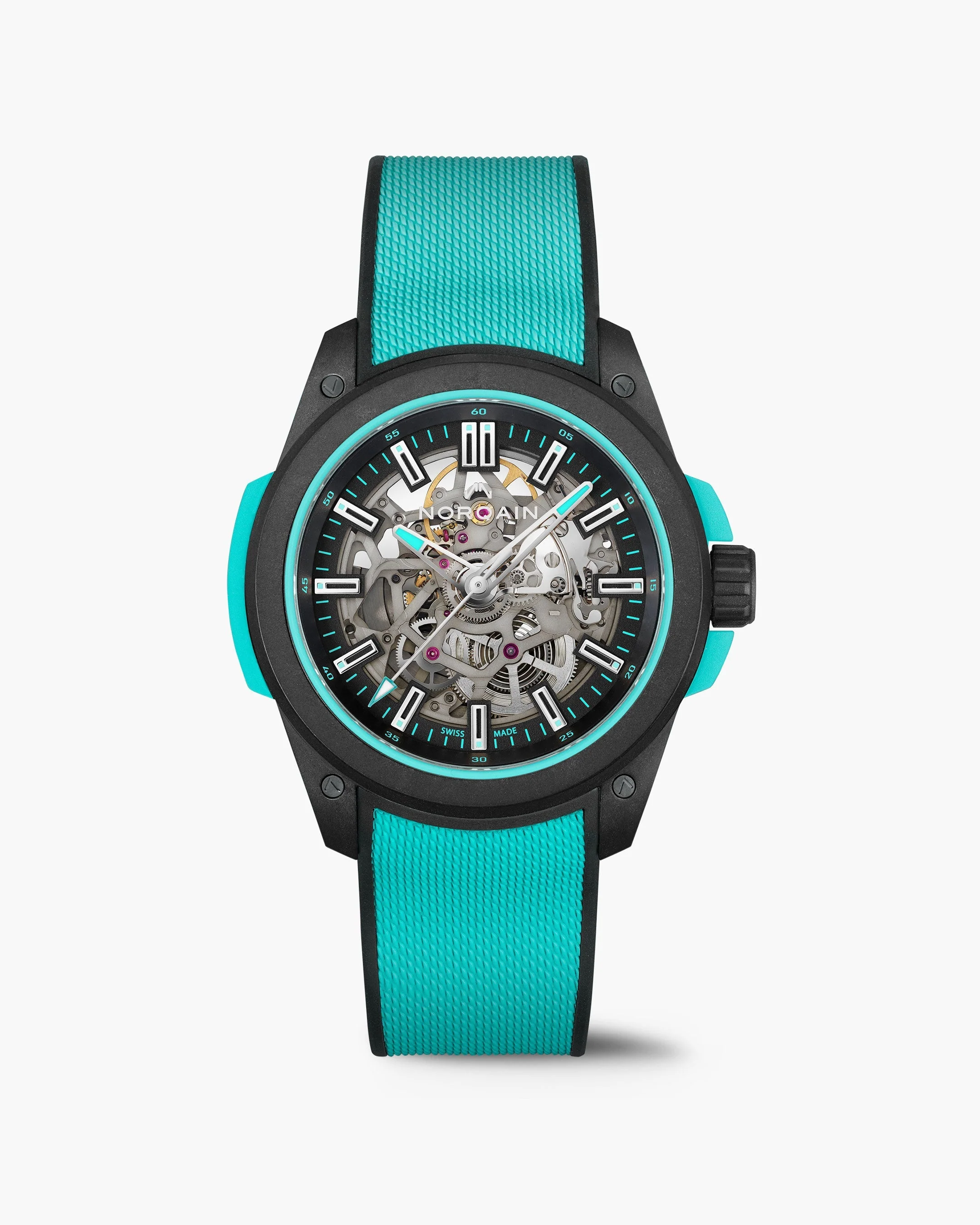
In brief. Norqain’s catalogue looks eclectic, but the most defensible identity sits in layered sports-case engineering: NORTEQ cages, titanium containers and rubber shock absorbers create a repeatable platform that colour and skeletonisation can vary.[1] [2] [3] [4] [5] [6] [7] [8]
A Young Brand With Four Distinct Product Lanes
Norqain began operations in 2018 under a founding team that includes Ben Küffer, Mark Streit and Ted Schneider. The surveyed catalogue spans Freedom chronographs, Independence skeleton chronographs, Wild ONE skeleton sports watches and Adventure chronographs.[1] [2]
Norqain began in 2018 with Ben Küffer, Mark Streit and Ted Schneider among the founding team. The surveyed range now covers four recognisable lanes: Freedom chronographs, Independence skeleton chronographs, Wild ONE skeleton sports watches and Adventure chronographs. That breadth is notable for a young independent brand, but it can also obscure what is genuinely distinctive.[1] [2]
A catalogue map helps separate style from architecture. Freedom and Adventure provide more conventional chronograph entry points, Independence pushes skeletonised complication, and Wild ONE makes the case itself a technical subject. Treating all four as one proposition would erase differences in movement provenance, materials and price that matter more than shared branding.[1] [2]
NORTEQ Is More Than a Colour Carrier
The 42 mm Wild ONE Skeleton uses separate NORTEQ top and bottom cage parts around a titanium container and rubber shock absorber. Norqain states that NORTEQ is six times lighter than steel and 3.5 times lighter than titanium.[3] [4]
The 42 mm Wild ONE Skeleton builds its case from separate NORTEQ top and bottom cage parts around a titanium container and rubber shock absorber. Norqain says the composite is six times lighter than steel and 3.5 times lighter than titanium. Those comparisons are maker claims, but the layered construction is directly described.[3] [4]
NORTEQ therefore does more than carry bright colour. The cage defines the exterior, the titanium container houses the movement, and the rubber element separates and cushions the layers. That repeatable arrangement gives Norqain a platform that can accept new palettes and openworked displays without reducing every release to a cosmetic variant. Long-term composite ageing is not documented in the cited sources.[3] [4]
Rubber and Layering Create the Sports Case
The official 42 mm Wild ONE Skeleton weighs 78 grams and is rated to 200 metres. The official case is rated as having survived shock testing at 5,000 g.[5] [7]
The official 42 mm Wild ONE Skeleton weighs 78 grams, is rated to 200 metres and is stated to have survived shock testing at 5,000 g. Low weight, substantial depth rating and the test claim together explain why the layered case is presented as engineering rather than decoration.[5] [7]
The evidence still has boundaries. Norqain does not publish the complete 5,000 g protocol here, and no independent impact comparison is supplied. A collector can credit the disclosed architecture and stated results while keeping the proof level clear. Water resistance, mass and shock survival are separate properties, even when the same case system contributes to all three.[5] [7]
Supplier-Based and Manufacture Calibres Need Separation
Its automatic calibre N08S is COSC-certified, runs at 4 Hz and provides 41 hours of power reserve. The Time+Tide selection shows prices ranging from USD 5,450 for the Adventure Sport Chrono to USD 8,490 for the Independence Skeleton Chrono limited edition.[6] [8]
The Wild ONE Skeleton’s N08S automatic calibre is COSC-certified, runs at 4 Hz and offers 41 hours of power reserve. Elsewhere in the surveyed catalogue, prices rise with chronograph and skeleton complexity, reaching USD 8,490 for the limited Independence Skeleton Chrono versus USD 5,450 for the Adventure Sport Chrono.[6] [8]
Movement language needs careful separation across those models. A COSC-certified supplier-based calibre, a manufacture-labelled chronograph and a skeletonised display can each be valuable, but they are not interchangeable claims. Buyers should identify the exact calibre and its provenance in the reference they want, rather than assuming that the most ambitious description applies throughout Norqain’s range.[6] [8]
How to Read the Range Without Following Colour Alone
The surveyed catalogue spans Freedom chronographs, Independence skeleton chronographs, Wild ONE skeleton sports watches and Adventure chronographs. The Time+Tide selection shows prices ranging from USD 5,450 for the Adventure Sport Chrono to USD 8,490 for the Independence Skeleton Chrono limited edition.[2] [8]
Price and architecture provide a clearer map than colour. The Adventure Sport Chrono establishes the lower end of this five-watch survey at USD 5,450, while the Independence Skeleton Chrono limited edition reaches USD 8,490. Between them, the Wild ONE case system offers the most repeatable technical language across variants.[2] [8]
Collectors should first choose the lane: conventional chronograph, skeleton complication or lightweight layered sports case. Colour can follow that decision. This order keeps a turquoise shock absorber from carrying more weight than calibre, construction or service implications. The sources provide a useful catalogue cross-section, but not a complete manufacturing breakdown, independent shock study or long-term record for NORTEQ.[2] [8]
The Dial Brief view
Norqain is easiest to understand when the range is divided by architecture before aesthetics. Freedom and Adventure offer chronograph propositions, Independence foregrounds skeletonised complication, and Wild ONE makes layered case construction the central event. The latter is the brand’s clearest shared technical language because NORTEQ cages, a titanium container and rubber shock absorber can be repeated across colours without losing structural meaning. That does not settle every claim. The 5,000 g result lacks a published full protocol here, composite ageing remains unknown, and calibre provenance varies across the catalogue. Buyers should compare the exact movement, case system and price of a reference, then use colour as the final choice rather than the organising principle.
What we know, and what remains unconfirmed
The sources do not publish the complete 5,000 g test protocol, independent impact results, long-term composite ageing data or a full movement-manufacturing breakdown across every model in the survey.