Blütezeit Builds a Viennese Dress Watch Through a DACH Supply Network
The Blütezeit No. 2.1 is designed in Vienna and built through a named European supplier network. Its Jochen Benzinger guilloché dial and thin hand-wound La Joux-Perret calibre show how a small brand can make coordination, provenance and optical legibility part of the product.
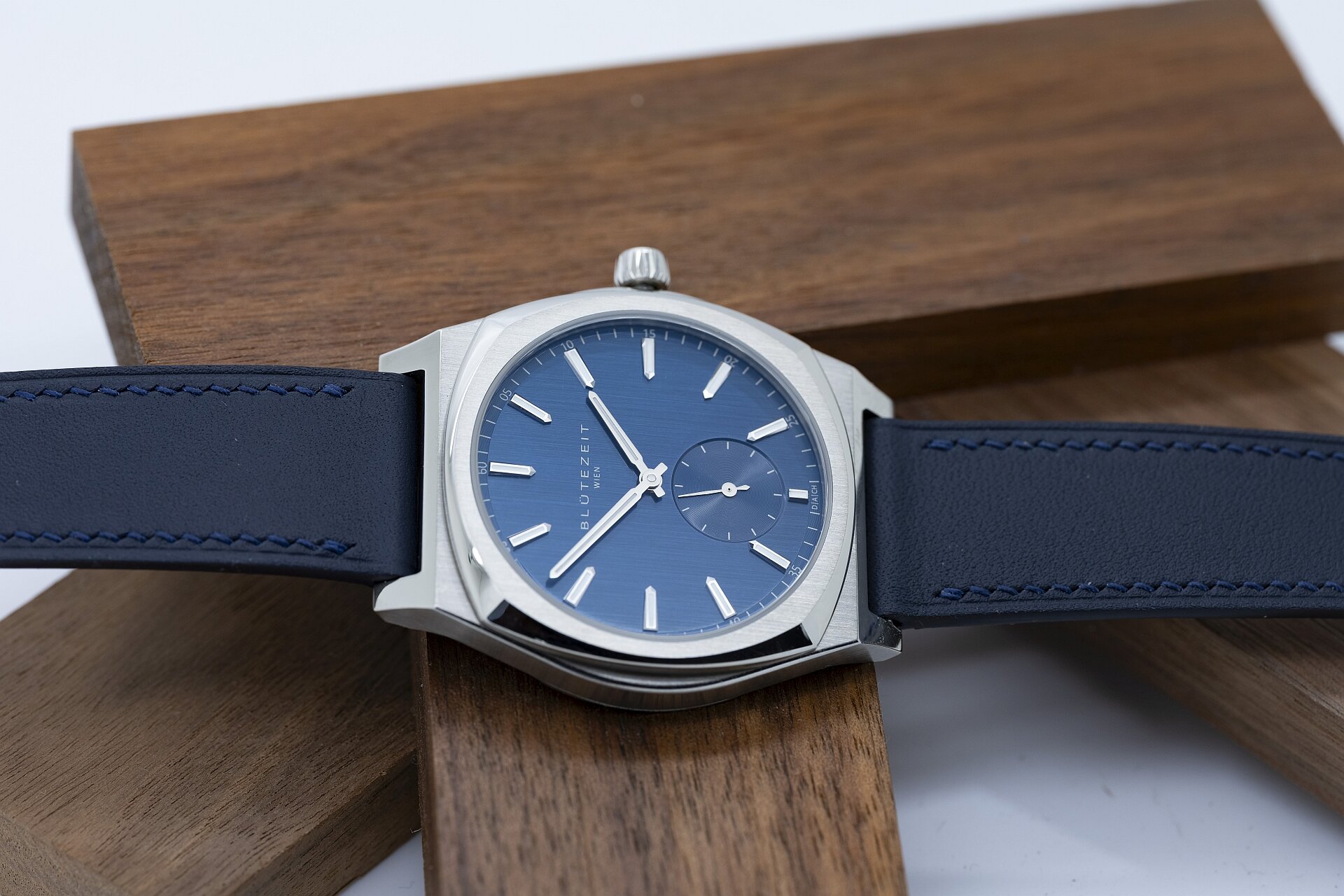
In brief. Blütezeit’s most useful independent-watchmaking claim is not total vertical integration but legible coordination: named suppliers, DACH provenance, Benzinger guilloché and a thin Swiss calibre are presented as a designed network rather than disguised outsourcing.[1] [2] [3] [4] [5] [6] [7] [8]
A Viennese Brand Built as a Supplier Network
Blütezeit is designed in Vienna and states that its watches are produced entirely in Europe. The brand says more than 95 percent of components come from Germany, Austria and Switzerland, with hands sourced from France.[1] [2]
Blütezeit presents itself as a Viennese design project rather than as a vertically integrated manufacture. The brand says production is entirely European, with more than 95 percent of components from Germany, Austria and Switzerland and the hands sourced from France. Naming that network makes outsourcing visible instead of disguising it.[1] [2]
For a small self-financed maker, coordination can be a legitimate form of authorship. The design task is to select specialists whose work forms one coherent watch, then remain accountable for the result. The published origin percentages are still maker claims rather than an audited bill of materials, so their value rests partly on continued transparency and traceable supplier relationships.[1] [2]
Benzinger Guilloché Does Functional Work
The No. 2.1 dial is guilloché by Jochen Benzinger with fine barleycorn and fish-scale patterns. Sapphire crystals front and back receive nine layers of colourless anti-reflective coating per side.[3] [5]
Jochen Benzinger guillochés the No. 2.1 dial with fine barleycorn and fish-scale patterns. These are not merely decorative labels: the two textures break reflected light differently, helping the dial reveal its structure as the viewing angle changes. The treatment gives the black surface activity without adding printed clutter.[3] [5]
That optical work supports legibility as well as craft value. A dark dress-watch dial can collapse into a flat field, but directional texture creates boundaries around the indications and small seconds. Buyers should still inspect the watch under ordinary light, because the sources describe the patterns and anti-reflective treatment without providing comparative legibility measurements.[3] [5]
A Thin Cushion Case With Everyday Limits
The steel case measures 37 mm across and about 7.1 mm thick including the crystal. Sapphire crystals front and back receive nine layers of colourless anti-reflective coating per side. The watch is rated to 3 ATM and carries a five-year warranty with stated exclusions.[4] [5] [7]
The steel case is 37 mm across and about 7.1 mm thick including the crystal. Sapphire appears front and back, with nine layers of colourless anti-reflective coating applied per side. The watch is rated to 3 ATM and carries a five-year warranty with stated exclusions.[4] [5] [7]
Those figures establish a restrained dress-watch profile with everyday limits. Thirty-seven millimetres and a little over seven millimetres should favour discretion under a cuff, while 3 ATM calls for caution around water. Extensive anti-reflective coating supports the dial’s optical purpose, but the sources do not assess coating durability, scratch behaviour or long-term seal performance.[4] [5] [7]
The LJP7380 Sets the Mechanical Character
The hand-wound La Joux-Perret LJP7380 runs at 3 Hz and provides 90 hours of power reserve without hacking seconds.[6]
The hand-wound La Joux-Perret LJP7380 runs at 3 Hz and provides a stated 90-hour power reserve. It does not hack, so pulling the crown will not stop the seconds hand for exact synchronisation. That combination gives the watch a long interval between winds while preserving a more traditional manual interaction.[6]
The calibre’s thinness is central to the overall design. A long-reserve hand-wound movement helps keep the case close to the wrist and leaves the caseback view open to finishing rather than a rotor. Missing hacking is a real functional tradeoff, but likely a secondary one for a dress watch whose appeal rests on proportion, dial craft and deliberate winding.[6]
What the DACH Label Commits the Brand to
Blütezeit is designed in Vienna and states that its watches are produced entirely in Europe. The brand says more than 95 percent of components come from Germany, Austria and Switzerland, with hands sourced from France. The first-series net price is EUR 5,000 before value-added tax and insured shipping.[1] [2] [8]
The first-series price is EUR 5,000 net, before value-added tax and insured shipping. At that level, the proposition depends on named specialist work, a thin Swiss calibre and transparent regional coordination rather than on scale or a vertically integrated factory. Taxes and delivery will materially change the final cost by destination.[1] [2] [8]
The DACH label functions as a commitment only if the brand continues to document what it means. Greater than 95 percent regional sourcing and fully European production are clear statements, but neither source supplies an independently audited component list, production total or long-term service record. Collectors can value the specificity while treating it as maker disclosure, not external certification.[1] [2] [8]
The Dial Brief view
Blütezeit offers a useful model of independent production because it makes supplier authorship visible. Benzinger provides identifiable guilloché work, La Joux-Perret supplies a thin 90-hour hand-wound calibre, and the brand frames those contributions through Viennese design and a stated DACH network. The case proportions and dial treatment are coherent with that approach. The ownership decision still requires precision: EUR 5,000 is a net price before tax and shipping, 3 ATM limits water exposure, the movement does not hack, and the origin percentages are not independently audited here. The strongest reason to consider the No. 2.1 is therefore transparent coordination and finished design, not a claim that every component was made under one roof.
What we know, and what remains unconfirmed
The 100 percent European and greater-than-95 percent DACH figures are maker claims rather than an independently audited bill of materials, and neither source provides timing measurements, production totals or long-term service data.