Edox Treats the Delfin 1973 as a Continuation, Not a Replica
The 2026 Edox Delfin 1973 is presented as a continuation rather than a faithful replica. Its twelve-sided bezel preserves recognition, while a new case, horizontally struck brass dial and a ladder of automatic and quartz references turn the old geometry into a broad modern collection.
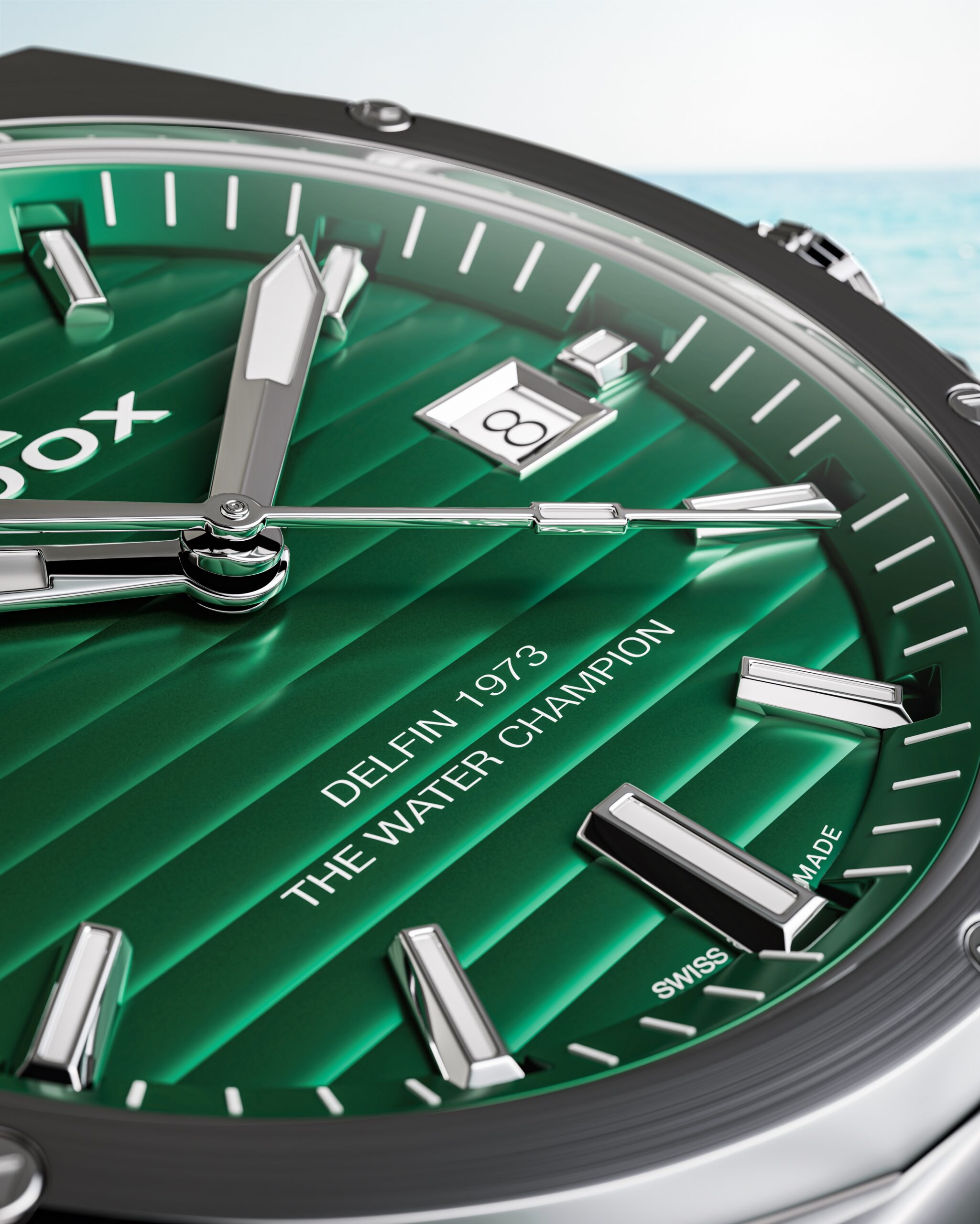
In brief. The new Delfin 1973 is stronger as an evolving collection than as nostalgia: the twelve-sided bezel preserves recognition, but a newly struck dial and multiple movement formats turn the old geometry into a broad modern platform.[1] [2] [3] [4] [5] [6] [7] [8]
Two Heritage Strategies in One Delfin Release
Edox describes the 2026 Delfin 1973 as a continuation rather than a faithful re-edition. The collection retains the twelve-sided bezel associated with the 1973 watch while introducing a new case. Published starting prices run from CHF 595 for quartz models to CHF 950 for the automatic, while the separate Delfin 1961 reissue costs CHF 1,495.[1] [2] [8]
Edox places two different approaches to heritage beside each other. The Delfin 1961 is the more faithful reissue and carries the higher CHF 1,495 price. The Delfin 1973 begins lower, with quartz models from CHF 595 and an automatic at CHF 950, because its purpose is to extend a recognisable design into a current family rather than reproduce one historical specification.[1] [2] [8]
That distinction protects the 1973 line from the wrong test. A continuation can change proportions, movements and dial construction while retaining a visual anchor. Collectors should therefore compare coherence, usability and value across the new range instead of asking whether every dimension matches an archival watch. Literal fidelity belongs to the separate 1961 proposition.[1] [2] [8]
The Twelve-Sided Bezel Carries the Family Resemblance
The collection retains the twelve-sided bezel associated with the 1973 watch while introducing a new case.[2]
The twelve-sided bezel does most of the identity work. It gives the collection an outline that remains recognisable even as the case beneath it is newly constructed. Because the bezel is retained as geometry rather than applied as a graphic reference, the historical link survives changes elsewhere in the watch.[2]
That approach is more flexible than a replica. A new case can accommodate current movements, water-resistance construction and several sizes while the dodecagonal frame keeps the family resemblance intact. The evidence establishes that broad design logic, but it does not provide an independent assessment of bezel-screw durability, seal life or tolerances between the twelve facets.[2]
A Struck Brass Dial Replaces Literal Replication
The brass dial receives a horizontal relief by repeated strikes with a linear tool. Dial choices include silver, black, blue and green, with steel bracelet or rubber strap options.[3] [7]
The horizontal texture is formed in brass through repeated strikes with a linear tool. This is a production process, not a printed illusion, and it gives the surface physical relief. Silver, black, blue and green variants then change how that relief catches light, with steel-bracelet and rubber-strap options extending the visual range.[3] [7]
Edox links the pattern to the seabed, but the more useful collector point is how it prevents the continuation from relying on bezel nostalgia alone. The dial introduces a new recognisable surface across the family. Neither source gives strike tolerances or reject rates, so consistency between individual dials remains a manufacturing question rather than a proven advantage.[3] [7]
Automatic and Quartz Create a Wide Platform
The automatic reference 80142 measures 41 mm and uses Edox calibre 80, based on the Sellita SW200. The automatic model has sapphire crystal, a screw-down crown and 200 metres of water resistance. The range also includes a 43 mm quartz chronograph, a 41 mm quartz date model and a smaller quartz date model.[4] [5] [6]
The 41 mm automatic reference 80142 uses Edox calibre 80, based on the Sellita SW200, and pairs sapphire with a screw-down crown and 200 metres of water resistance. The wider range also includes a 43 mm quartz chronograph, a 41 mm quartz date watch and a smaller quartz date option.[4] [5] [6]
This ladder lets the case language reach different buyers without pretending every reference is mechanically equivalent. The automatic offers a familiar Swiss movement and a clearly documented dive-ready specification, while quartz broadens function and entry price. Buyers should verify the exact dimensions and features of the chosen reference rather than transferring the automatic model’s details to the entire family.[4] [5] [6]
What the Collection Proves and What It Does Not
Published starting prices run from CHF 595 for quartz models to CHF 950 for the automatic, while the separate Delfin 1961 reissue costs CHF 1,495. The automatic model has sapphire crystal, a screw-down crown and 200 metres of water resistance.[8] [5]
Published pricing makes the 1973 collection accessible relative to the separate 1961 reissue. Quartz starts at CHF 595 and the automatic at CHF 950, while the more literal heritage piece costs CHF 1,495. That spread reinforces the idea of a scalable platform rather than a single prestige re-creation.[8] [5]
The evidence base also requires restraint. The specialist introduction is explicitly sponsored, and neither source supplies independent pressure, rate or long-term seal testing. The documented facts are still useful, particularly the movements, construction and pricing, but promotional enthusiasm should not be mistaken for comparative ownership evidence. The collection’s promise is breadth and recognisable design, not proven superiority.[8] [5]
The Dial Brief view
The Delfin 1973 should be judged as a collection architecture. Its twelve-sided bezel provides continuity, the struck dial adds a new physical signature, and the range moves from affordable quartz to a Sellita-based automatic with sapphire, a screw-down crown and 200 metres of stated water resistance. That breadth is a feature if buyers compare exact references carefully. It becomes a source of confusion if one model’s specifications are assumed to apply to all. The price gap to the CHF 1,495 Delfin 1961 also clarifies the choice: buy the 1961 for a more faithful reissue proposition, or read the 1973 as Edox adapting historical geometry to multiple modern uses. Independent performance evidence remains absent.
What we know, and what remains unconfirmed
The independent-looking second source is explicitly sponsored marketing, and the sources provide no independent water-resistance test, rate measurement, dial-production tolerances or long-term assessment of the bezel screws and seals.