TAG Heuer Uses Solargraph to Mark Zandvoort’s Final Formula 1 Lap
TAG Heuer marks Zandvoort’s final scheduled Dutch Grand Prix with two 38 mm Formula 1 Solargraph editions. Orange is distributed across the bezel and display rather than confined to a commemorative badge, while the TH50-00 light-powered movement gives the watches a practical life beyond the race weekend.
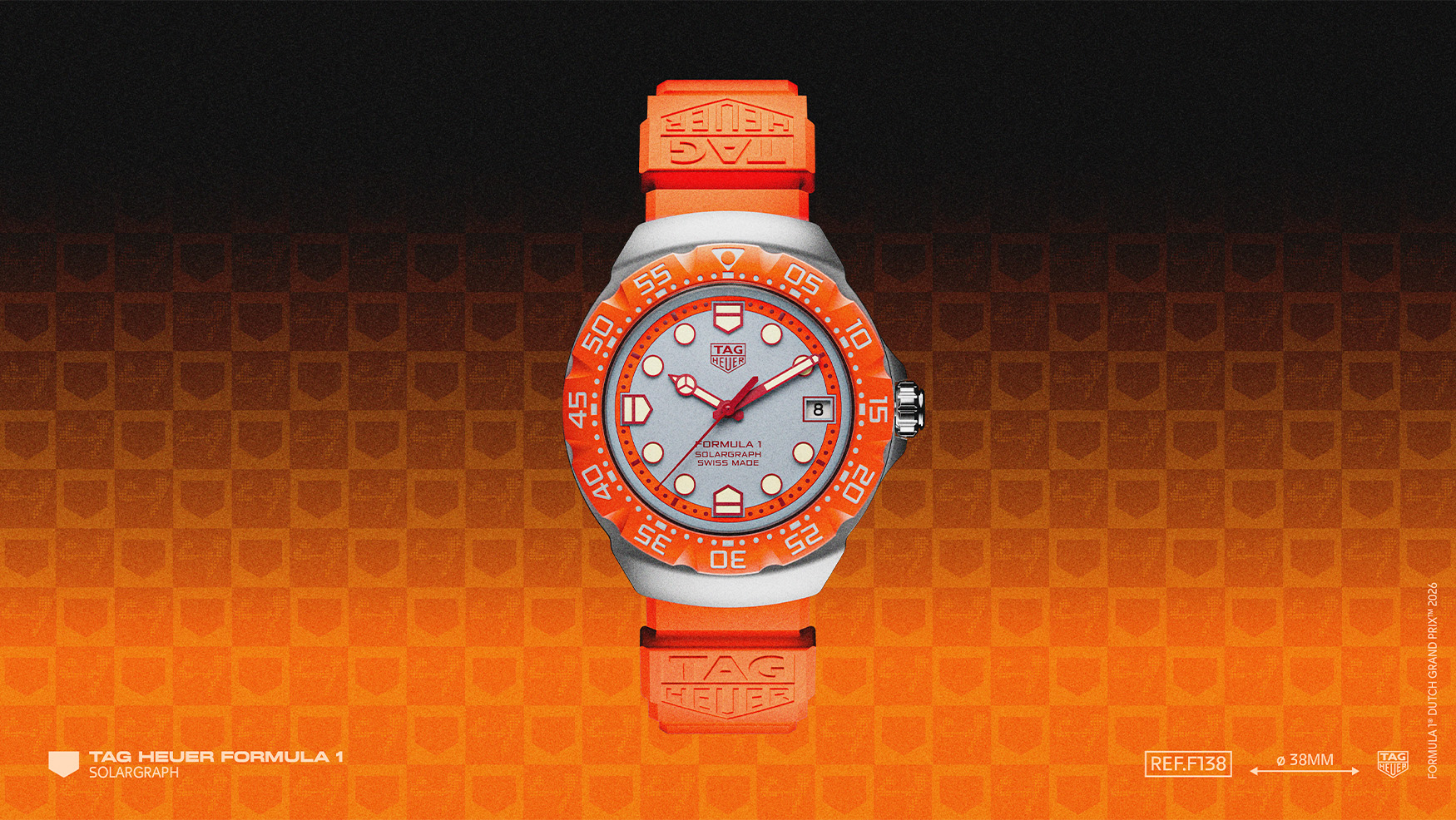
In brief. The Zandvoort editions work because the commemoration is built into colour and timing rather than added as a logo: the final scheduled Dutch Grand Prix gives the orange treatment a finite context, while Solargraph keeps the watch usable after the event.[1] [2] [3] [4] [5] [6] [7] [8]
A Watch Tied to Zandvoort’s Final Scheduled Race
TAG Heuer created two Formula 1 Solargraph editions for the final scheduled Formula 1 Dutch Grand Prix at Zandvoort.[1]
The wording around the event matters. These watches are tied to the final Dutch Grand Prix currently scheduled at Zandvoort, not to proof that Formula 1 can never return. That finite calendar moment gives the release urgency without requiring a permanent historical claim. It also explains why two numbered production runs make sense as event objects rather than as ordinary colour additions.[1]
A sponsorship watch can easily become a logo exercise. Here the stronger editorial reading is timing: the edition captures a known end point in the present calendar. Collectors should preserve that qualification when discussing provenance. The watch records the last scheduled race in the current run, while future calendar decisions remain outside what either cited source can establish.[1]
Orange Works as a Design System
The orange TH-Polylight bezel is paired with a grey opaline dial, orange chapter ring and red accents.[3]
Orange works across several layers. The TH-Polylight bezel makes the largest statement, the chapter ring carries the colour inward, and red accents add a second warm signal against the grey opaline dial. That distribution creates a coherent visual system linked to the Dutch crowd atmosphere, rather than placing a single orange emblem on an otherwise standard Formula 1.[3]
Material choice supports the effect. The coloured polymer bezel can deliver a broad matte surface while the sandblasted steel case keeps reflections subdued. Because the dial stays grey, the watch remains readable as a compact instrument under the event palette. The design is still conspicuous, but its cues are structural and repeated, which gives the commemoration more depth than a caseback inscription alone.[3]
The 38 mm Formula 1 Platform
Both watches use a 38 mm sandblasted steel case measuring 10.2 mm thick and 42 mm lug to lug. The front crystal is sapphire and water resistance is rated to 100 metres.[2] [6]
The 38 mm case, 42 mm lug-to-lug span and 10.2 mm thickness establish a compact platform by current sports-watch standards. Sandblasting reduces jewellery-like shine, while sapphire and a 100-metre rating supply a credible daily-wear baseline. Those facts make the watch easier to assess independently of the Formula 1 association.[2] [6]
Compact dimensions are especially relevant because bright orange can make an object appear larger than its measurements suggest. The restrained steel envelope contains that visual energy without removing it. Water resistance and sapphire also mean the commemorative treatment is attached to practical hardware, although the sources do not provide an independent pressure test or measured wear assessment.[2] [6]
Solargraph Supplies the Practical Argument
The watches use the light-powered TH50-00 Solargraph quartz movement. One minute of direct sunlight is stated to provide about one day of operation, while a full charge provides up to ten months in darkness.[4] [5]
Solargraph is the functional centre of the release. A stated minute of direct sunlight yields roughly a day of operation, and a full charge can sustain the watch for up to ten months in darkness. The useful benefit is reduced concern about routine battery depletion, not an assertion that the accumulator will never require replacement.[4] [5]
Those figures are brand specifications rather than independent charging results. Light intensity, storage conditions and the age of the energy cell can affect real use, while neither source publishes replacement cost or measured accuracy. Still, the movement suits an event watch well: it can remain ready through long periods off the wrist and continue to function after the specific race it commemorates has passed.[4] [5]
Two Editions, Two Levels of Orange
The orange-rubber version is limited to 1,500 pieces, while the online steel-bracelet version is limited to 1,000 pieces. Published US prices are USD 2,150 on rubber and USD 2,250 on steel.[7] [8]
The rubber edition is the louder interpretation, limited to 1,500 pieces and priced at USD 2,150. The steel-bracelet version is limited to 1,000 pieces, sold online and priced at USD 2,250. The USD 100 difference is small relative to the total, so the decision turns more on wearing character, sales channel and the desired amount of orange.[7] [8]
Production numbers should be recorded precisely rather than collapsed into one total. The straps, channels and edition sizes define distinct references even though the case, dial language and movement are shared. Scarcity alone does not determine the better choice. The stronger collector comparison is whether the orange rubber completes the race-day concept or whether the steel bracelet gives the design a longer life in ordinary use.[7] [8]
The Dial Brief view
These Zandvoort editions are strongest when treated as compact, practical Formula 1 watches with a specific calendar context. The 38 mm case and 100-metre rating give them everyday credibility, while the TH50-00 reduces the upkeep associated with an occasional commemorative piece. Orange is applied consistently enough to make the association visible without depending on a logo. Buyers should keep three limits in view: the Dutch Grand Prix is leaving the current schedule, not necessarily disappearing forever; the charging and autonomy figures are not independently tested here; and the two references have different edition sizes and channels. Choose between them for wearing character, not simply because one run is numerically smaller.
What we know, and what remains unconfirmed
Neither source supplies independent charging tests, accumulator replacement cost, measured accuracy or confirmation that the Dutch Grand Prix will never return after the current calendar exit.