Singer Gives the Valjoux 72 a Second Life, Not a Replica
Singer does not reproduce the Valjoux 72 for the Heritage V72. It restores original unassembled new-old-stock movements, makes its intervention visible through contemporary finishing, and installs them in a compact new chronograph. That combination places conservation, authorship and provenance at the centre of the watch.
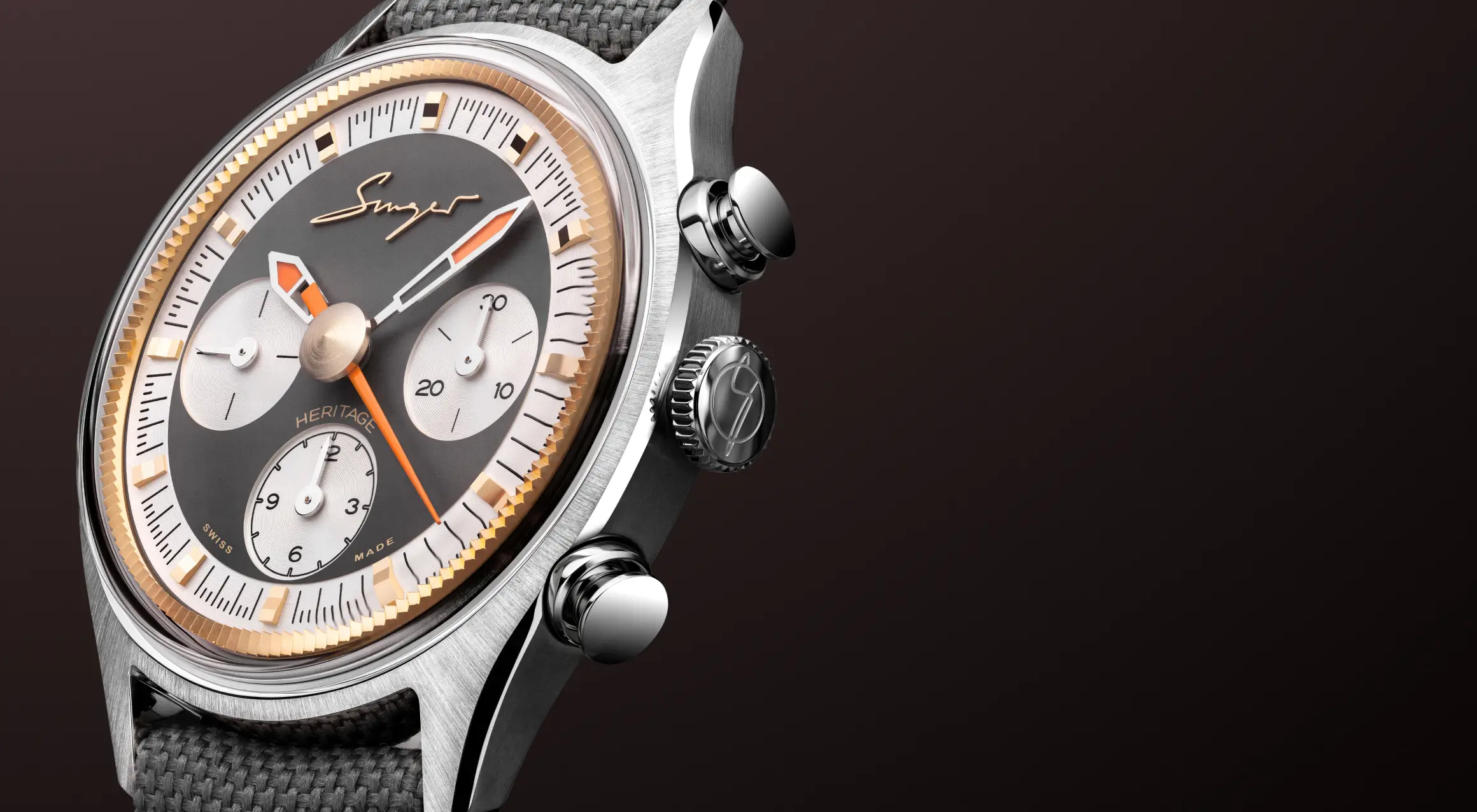
In brief. Singer’s Heritage V72 is most convincing when read as conservation with authorship: the historic calibre remains real, while the visible finishing, case and commercial proposition are explicitly contemporary.[1] [2] [3] [4] [5] [6] [7] [8]
What Singer Means by Restoration
The Heritage V72 uses original unassembled new-old-stock Valjoux 72 movements restored, finished and assembled by Singer Reimagined. The steel SR621 case measures 38.8 mm across and 13.25 mm thick, with glassbox sapphire crystals on both sides and 50 metres of water resistance.[1] [2]
Restoration here describes the movement basis, not the whole watch. The old calibre supplies material continuity, while the new case and visible finish declare a current author. That clear boundary is more useful than language that would imply either an untouched historical object or a newly manufactured clone.[1] [2]
For collectors, the relevant task is to separate what the sources document from what still requires experience. Define the material starting point and separate restoration from reproduction. The cited material establishes these points, but it does not support broader claims about long-term ownership, measured performance or future market value.[1] [2]
Why the Valjoux 72 Carries Weight
The restored SG7201 calibre retains a frequency of 18,000 vibrations per hour and a 44-hour power reserve. Singer frosts the bridges, hand-polishes chamfers and screws, rhodium-plates steel parts and applies a blue ALD treatment to the switch component.[3] [4]
The Valjoux 72 matters because it connects the watch to a long twentieth-century chronograph tradition, yet history alone does not determine present quality. Its low frequency and stated reserve establish period character. Singer still has to demonstrate how restored examples perform consistently after decades in storage.[3] [4]
For collectors, the relevant task is to separate what the sources document from what still requires experience. Establish the calibre’s historical reach and enduring service culture. The cited material establishes these points, but it does not support broader claims about long-term ownership, measured performance or future market value.[3] [4]
The Finishing That Makes the Intervention Visible
The Y-shaped chronograph bridge is inscribed “Restored by Singer,” making the intervention visible rather than disguising it as untouched vintage material. The steel version is limited to 50 pieces at CHF 23,000 before tax, while the gold version is limited to 20 pieces at CHF 45,000 before tax.[5] [6]
The inscription on the chronograph bridge makes authorship legible. Frosting, polished edges, plated steel and the blue-treated switch component do more than beautify the calibre. They show exactly where Singer has intervened, allowing the owner to distinguish surviving historical architecture from contemporary presentation.[5] [6]
For collectors, the relevant task is to separate what the sources document from what still requires experience. Explain how Singer changes finish and presentation while retaining the historical mechanism. The cited material establishes these points, but it does not support broader claims about long-term ownership, measured performance or future market value.[5] [6]
A Contemporary Case Around Old Mechanics
The Heritage V72 is scheduled for release in early November 2026 through Singer retailers and direct sales. The Valjoux 72 debuted in 1938, remained in production until 1974 and powered chronographs from several major twentieth-century brands.[7] [8]
A 38.8 mm case gives the restored calibre a compact frame, while the double sapphire construction makes movement display part of daily ownership. The result is not a museum housing. It is a contemporary watch designed around old mechanics, with moderate water resistance and a scheduled retail release.[7] [8]
For collectors, the relevant task is to separate what the sources document from what still requires experience. Assess dimensions, dial architecture and the choice to reveal the movement. The cited material establishes these points, but it does not support broader claims about long-term ownership, measured performance or future market value.[7] [8]
Originality, Scarcity and the Collector Contract
The Heritage V72 uses original unassembled new-old-stock Valjoux 72 movements restored, finished and assembled by Singer Reimagined. The steel SR621 case measures 38.8 mm across and 13.25 mm thick, with glassbox sapphire crystals on both sides and 50 metres of water resistance.[1] [2]
The steel and gold limits create scarcity, but the stronger collector contract is disclosure. Buyers need to know what was original, what was restored and what can be serviced. Price may reflect scarce movements and labour, yet individual movement records and independent long-term assessment remain important missing evidence.[1] [2]
For collectors, the relevant task is to separate what the sources document from what still requires experience. Frame provenance, price, serviceability and the limits of the available evidence. Singer and Monochrome document the restoration and specifications, but no independent long-term timing or service assessment is yet available, and provenance records for each individual base movement have not been published.[1] [2]
The Dial Brief view
Collectors should treat the Heritage V72 as a layered object. The mechanism is historical, but its finish, case, dial and route to market belong to 2026. That is not a weakness when the intervention is disclosed. The questions are whether each movement has an adequate provenance record, whether Singer can support future service, and whether the premium makes sense for restoration rather than untouched vintage condition. Comparison with a period chronograph will not settle the issue because the two objects promise different things. One preserves an assembled historical watch; the other gives unused historical mechanics a documented new context. Buyers should decide which form of continuity they actually value.
What we know, and what remains unconfirmed
Singer and Monochrome document the restoration and specifications, but no independent long-term timing or service assessment is yet available, and provenance records for each individual base movement have not been published.