Seiko Rebuilds the 1913 Laurel Through Enamel and Urushi
The Presage HCC005 and HCC006 translate Japan’s first wristwatch into handmade enamel and lacquer dials inside a modern 39.6 mm case. The pair shows how a large Japanese manufacture can keep specialist dial crafts visible at prices far below atelier-scale production.
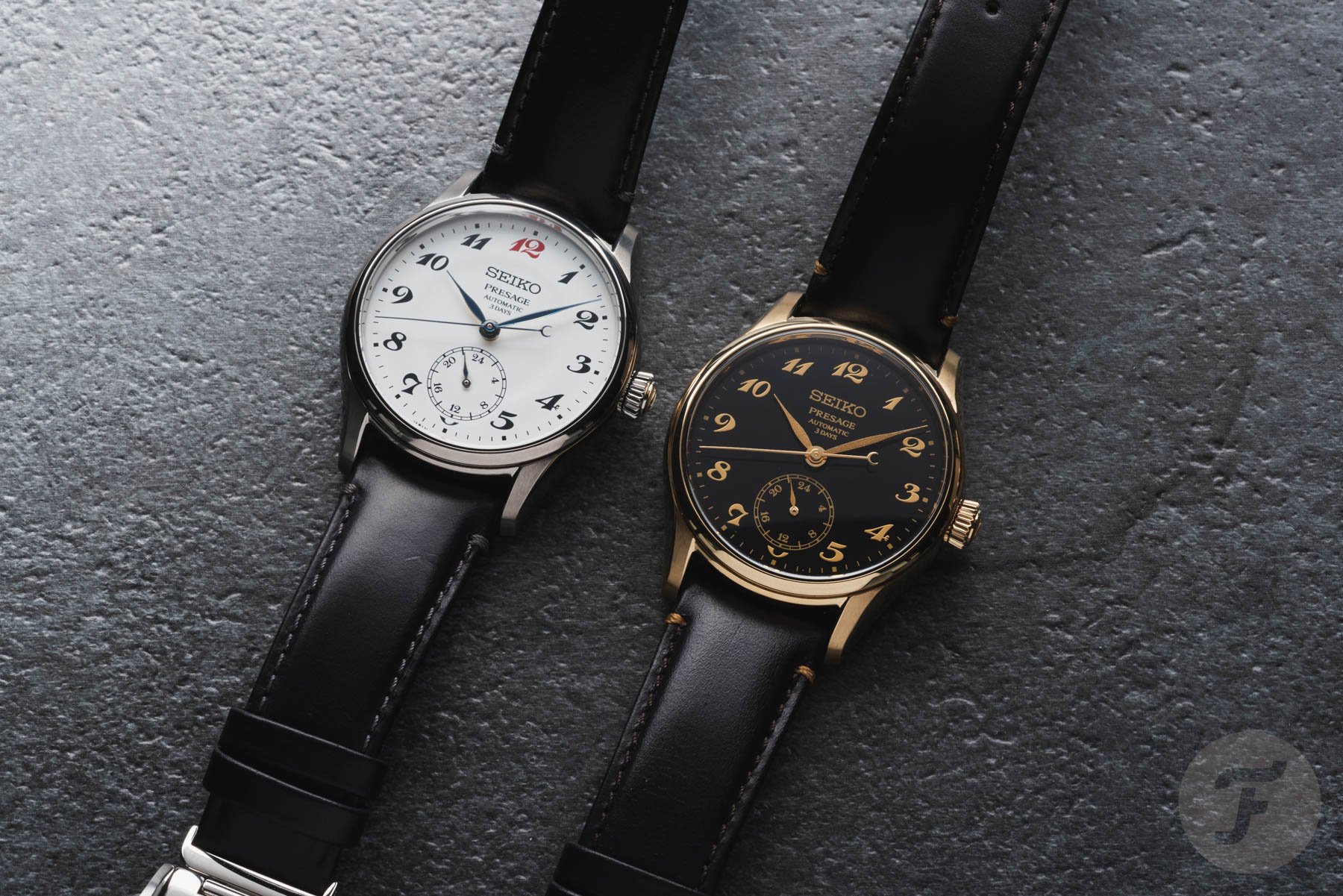
In brief. The two Presage models are strongest as a controlled comparison: identical modern architecture lets enamel and urushi express two different readings of the Laurel without pretending to reproduce a 1913 watch.[1] [2] [3] [4] [5] [6] [7] [8]
What the 1913 Laurel Contributes
Both models reinterpret Seiko’s 1913 Laurel, recognised as Japan’s first wristwatch. The HCC005 uses a handmade white enamel dial with italic Arabic numerals and a red 12.[1] [2]
The Laurel reference supplies a historical grammar rather than a blueprint. Arabic numerals, the red 12 and restrained time-only presentation recall the early wristwatch, yet the dimensions and manufacturing belong to the present. That separation matters because reinterpretation can be judged on coherence without demanding false period fidelity.[1] [2]
The HCC005 borrows the Laurel’s visual vocabulary without copying its early case. Its enamel dial, italic numerals and red 12 carry the historical reference, while the modern size and production methods remain visible. That tension is more honest than presenting the watch as a replica.[1] [2]
The HCC005 and the Discipline of White Enamel
The HCC006 uses a black hand-lacquered urushi dial in a yellow-gold-tone PVD steel case. The enamel work is attributed to Mitsuru Yokosawa and Kazunori Uchiyama, while the urushi team works under Isshu Tamura.[3] [4]
White enamel makes small variations in surface and firing part of the dial rather than defects to hide. The named specialists give the craft a traceable human context. The red numeral and italic typography then keep the result from reading as a generic formal watch, even though the underlying layout is deliberately calm.[3] [4]
Naming Yokosawa, Uchiyama and Tamura matters because enamel and urushi are not anonymous decorative labels here. Their teams are tied to specific processes and surfaces. The attribution lets collectors evaluate the craft claim without treating every irregularity as either a defect or automatic proof of handwork.[3] [4]
The HCC006 and the Depth of Black Urushi
Both cases measure 39.6 mm across and 46.8 mm long with a dual-curved sapphire crystal. The automatic 6R5H calibre offers about 72 hours of reserve and a 24-hour indicator.[5] [6]
Black urushi creates a different kind of depth. Lacquer depends on layered application and finishing, so the surface changes with light instead of delivering the flat certainty of paint. The yellow-gold-tone case heightens that warmth, making the HCC006 the more emphatic interpretation of the shared architecture.[5] [6]
The 39.6 mm case and 6R5H calibre are shared, so the urushi version does not buy a different technical platform. Its higher price rests mainly on lacquer, colour and the gold-tone case treatment. The 72-hour reserve and 24-hour indicator remain common to both references.[5] [6]
Two Craft Traditions, Two Different Propositions
Both models reinterpret Seiko’s 1913 Laurel, recognised as Japan’s first wristwatch. The HCC005 uses a handmade white enamel dial with italic Arabic numerals and a red 12.[1] [2]
The price gap is therefore best understood through material expression rather than function. Neither version has independent timing data, known production totals or long-term dial-ageing evidence. The choice rests on which craft tradition feels more convincing in the common modern case, with those unknowns left intact.[1] [2]
European pricing and September 2026 availability provide a clear launch reference, but neither says how many will be made. Choosing between them is primarily a choice between cool enamel restraint and warmer lacquer depth. Independent timing and long-term ageing evidence remain absent for both.[1] [2]
The Dial Brief view
The Laurel reference supplies a historical grammar rather than a blueprint. Arabic numerals, the red 12 and restrained time-only presentation recall the early wristwatch, yet the dimensions and manufacturing belong to the present. That separation matters because reinterpretation can be judged on coherence without demanding false period fidelity. Black urushi creates a different kind of depth. Lacquer depends on layered application and finishing, so the surface changes with light instead of delivering the flat certainty of paint. The yellow-gold-tone case heightens that warmth, making the HCC006 the more emphatic interpretation of the shared architecture.
What we know, and what remains unconfirmed
The review provides a short hands-on impression but no independent rate test, long-term dial ageing evidence, production quantities or confirmed pricing outside the cited European market.