CIGA Design Warms Up the Hunter Without Making It Retro
Rose-gold and brown-gold coatings soften the Hunter skeleton watch, while its X-shaped CD-07 architecture remains emphatically contemporary. Collectors can see a Chinese design-led brand evolving one recognisable platform through colour, movement display and accessible pricing rather than invented heritage.
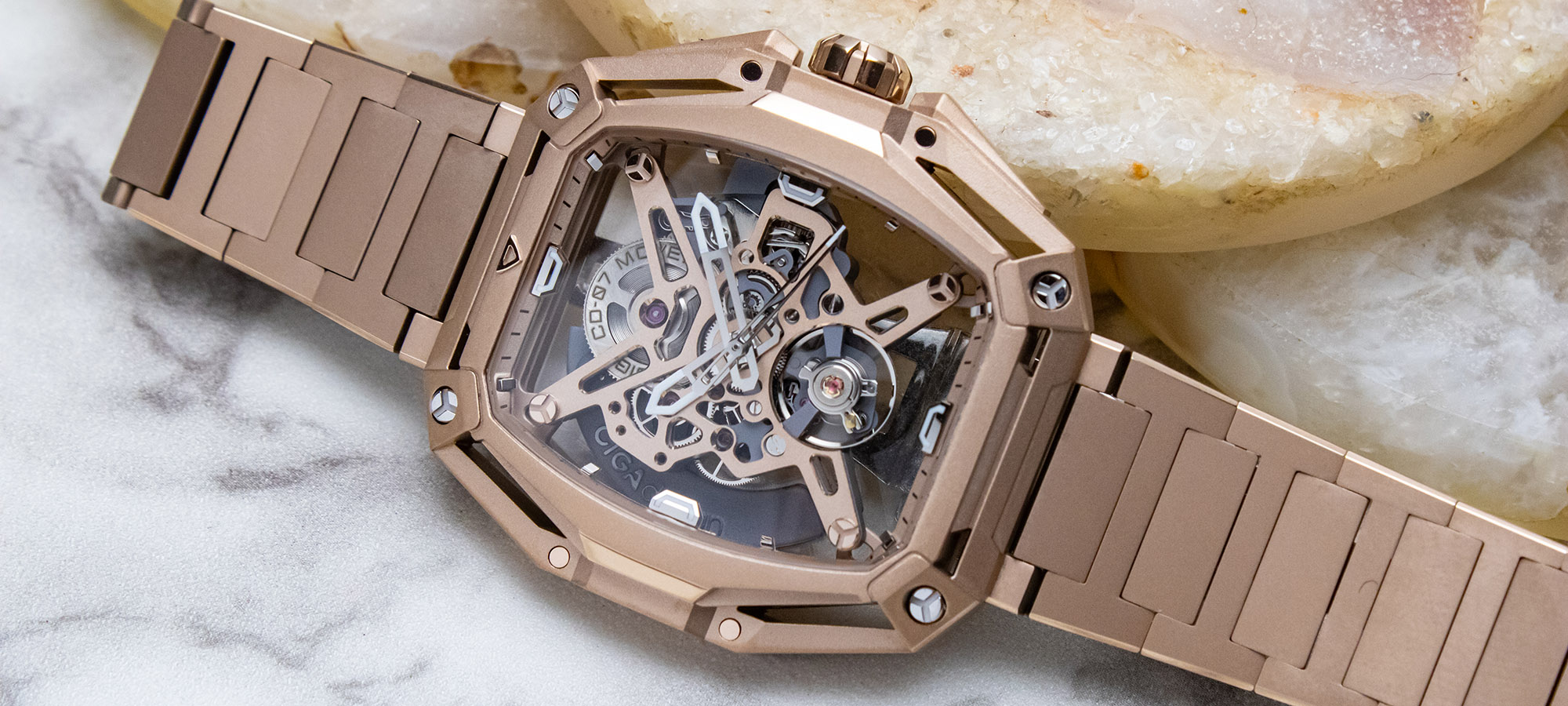
In brief. The Hunter Vintage works precisely because its name is misleading: warmer coatings change the emotional register, but the skeleton architecture, exposed rotor and imposing tonneau case remain a contemporary CIGA design statement.[1] [2] [3] [4] [5] [6] [7] [8]
Why “Vintage” Describes Colour, Not Architecture
The Hunter Vintage is offered in rose-gold-tone and brown-gold-tone case treatments. Its 316L steel case measures 43 mm wide and 48 mm lug to lug.[1] [2]
The word vintage usually promises an older proportion, historical reference or restrained dial. Here it chiefly describes warmth. Gold-tone surfaces and brown accents soften the object, but the openworked tonneau body remains unmistakably contemporary. The naming tension is useful because it forces the design change to be identified precisely.[1] [2]
Neither treatment changes the 43 mm width or 48 mm lug span, so Vintage should not be read as a return to small historical proportions. The warmer palette changes the mood of the same large openworked object. That is a colour decision, not a new architectural category.[1] [2]
A Large Tonneau Case With Open Structure
Sapphire crystals are fitted to both the front and back, while water resistance is rated to 30 metres. The skeleton movement is arranged around an X-shaped bridge structure with the barrel at 12 and balance at 6.[3] [4]
A 43 mm tonneau watch has physical presence even before its open structure amplifies apparent size. Sapphire on both sides supports the display concept, while the modest water rating sets a practical boundary. The case should therefore be assessed as a design frame first, not assumed to be an all-purpose sports shell.[3] [4]
The front and rear sapphire make the movement view part of the case specification, while 30 metres of resistance limits the practical brief. Buyers considering it for frequent wear should treat that rating and the broad tonneau footprint as real constraints, not footnotes to the skeleton design.[3] [4]
How the X-Shaped Skeleton Organises the Movement
The in-house CD-07 automatic movement runs at 28,800 vibrations per hour and offers 40 hours of reserve. A narrow 120-degree rotor is designed to frame the bridge anchors and carries the brand name.[5] [6]
The X-shaped bridge gives the eye a stable route through a busy mechanism. Locating the barrel high and the balance low creates a strong vertical axis, while negative space supplies the spectacle. Legibility still depends on contrast between hands, indices and moving parts, which photographs cannot settle for every light condition.[5] [6]
The CD-07’s 120-degree rotor preserves much of the rear view instead of masking the bridge structure. Its 4 Hz rate and 40-hour reserve are ordinary enough to keep attention on layout. The unanswered question is whether the hand contrast stays readable when the exposed parts catch direct light.[5] [6]
The CD-07 and Its Framing Rotor
The matching H-link bracelet uses a hidden butterfly clasp without micro-adjustment. The listed retail price at publication is USD 599.[7] [8]
The CD-07 keeps the architecture visually coherent because its rotor does not simply cover the back. Its short arc frames the bridge anchors and preserves a view into the calibre. Frequency and reserve establish the operating baseline, but they do not substitute for independent rate measurements or long-term winding observations.[7] [8]
The movement and bracelet reveal different priorities. The calibre is arranged to stay visible from both sides, while the hidden butterfly clasp offers no micro-adjustment. One serves spectacle; the other may complicate fit. Neither the frequency nor the reserve resolves that everyday tradeoff.[7] [8]
A USD 599 Design Object With Clear Compromises
The Hunter Vintage is offered in rose-gold-tone and brown-gold-tone case treatments. Its 316L steel case measures 43 mm wide and 48 mm lug to lug.[1] [2]
At the stated price, the proposition is unusually direct: a large skeleton object, an identifiable in-house architecture and coated finishing, balanced by a bracelet without micro-adjustment and limited evidence about ageing. Buyers should decide whether the visual authorship outweighs those ownership uncertainties.[1] [2]
USD 599 makes the design accessible, but coated surfaces and a fixed-fit clasp shift part of the risk into ownership. The watch has a recognisable mechanical identity at that price. What remains untested is how the finish, bracelet and winding system behave after sustained wear.[1] [2]
The Dial Brief view
The word vintage usually promises an older proportion, historical reference or restrained dial. Here it chiefly describes warmth. Gold-tone surfaces and brown accents soften the object, but the openworked tonneau body remains unmistakably contemporary. The naming tension is useful because it forces the design change to be identified precisely. The X-shaped bridge gives the eye a stable route through a busy mechanism. Locating the barrel high and the balance low creates a strong vertical axis, while negative space supplies the spectacle. Legibility still depends on contrast between hands, indices and moving parts, which photographs cannot settle for every light condition.
What we know, and what remains unconfirmed
The evidence covers one rose-gold review sample; there is no long-term coating-wear test, water-resistance test, bracelet durability record or independent timing measurement.