Kiwame Tokyo Turns Asakusa Rooflines Into a Rectangular Watch
The Kiwame Tokyo Yane is the Asakusa independent brand's first rectangular watch, shaped around the lines and construction of historic Japanese temple roofs. A 44 by 26.5 mm case, lacquer dial, ridge-shaped noon marker and rafter-patterned back carry that architectural idea, while a compact Miyota automatic keeps the display to hours and minutes.
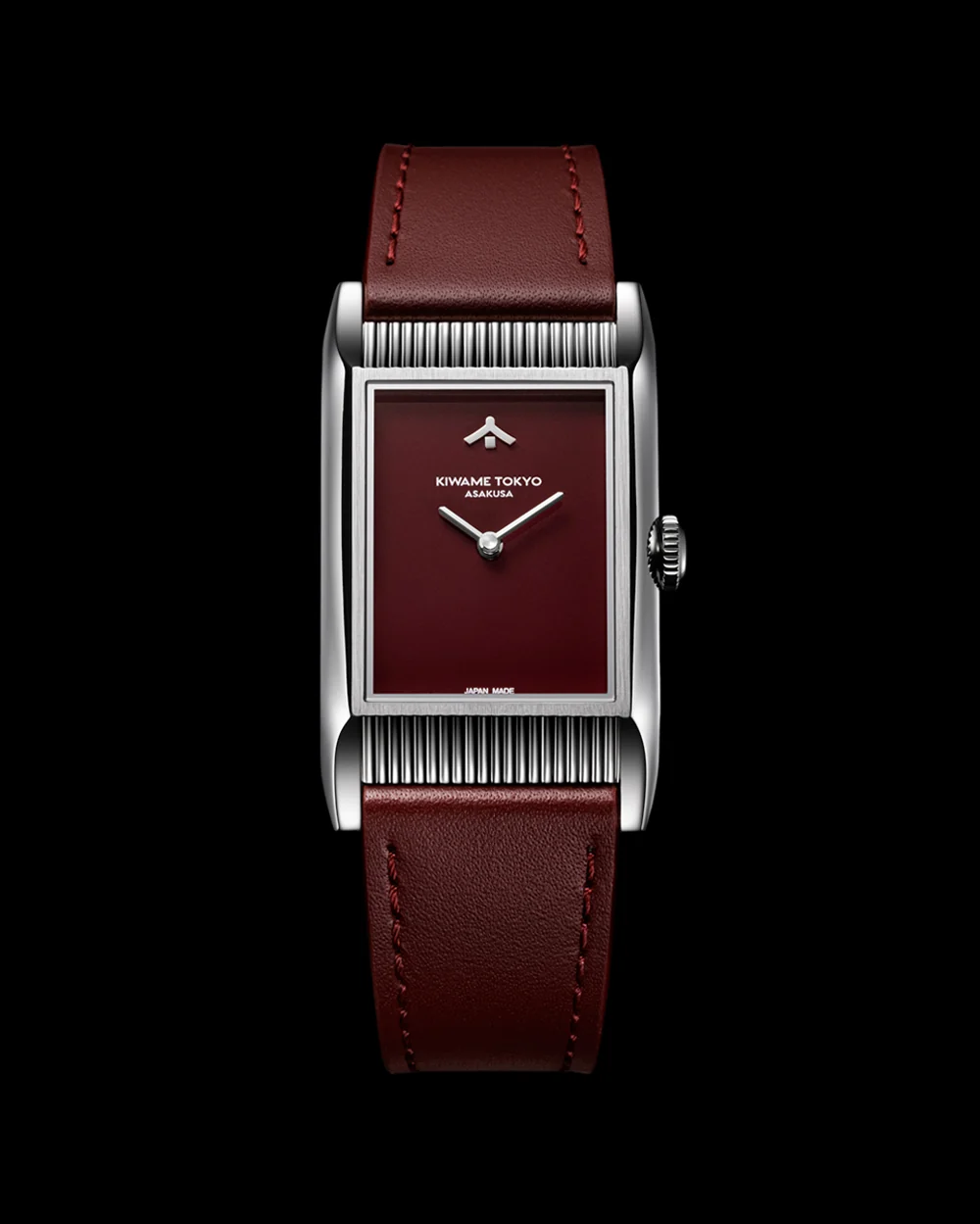
In brief. Yane succeeds when read as architectural translation rather than decorative borrowing: its narrow rectangular case, single ridge-shaped noon marker, lacquer surface and rafter-patterned back turn Asakusa roof construction into a coherent watch vocabulary.[1] [2] [3] [4] [5] [6] [7] [8]
Details from every angle
From Asakusa Roofs to a Rectangular Case
Kiwame Tokyo is an independent Japanese microbrand based in Asakusa and founded by Masami Watanabe. That location is not incidental to Yane. The model is presented as the brand's first rectangular watch and takes its form from historic Japanese temple roofs. The premise is specific enough to be tested across the object: the case outline, dial marker and reverse pattern each need to contribute to the same architectural language rather than using a local reference only as a name.[1] [2]
Read on those terms, Yane is an exercise in translation. Roof construction becomes proportion, line and surface rather than a miniature picture of a building. That approach keeps the design connected to Asakusa without turning the watch into a generic heritage object. The sources document the maker's stated inspiration and the launch details, but they do not independently test the watch on wrist. The supported conclusion is therefore about coherence of vocabulary, not about comfort or execution beyond what the specifications and official imagery show.[1] [2]
Why the 44 by 26.5 mm Proportions Matter
The steel case measures 44 mm long, 26.5 mm wide and 9.7 mm thick. The narrow width is central to the roofline reading because it gives the watch a vertical, compressed face instead of treating rectangular design as a broad square with softened corners. Length supplies visual presence, while the restrained width preserves the tension between the long sides. The 9.7 mm thickness places the automatic movement inside that compact outline without changing the basic two-dimensional idea presented from the front.[3]
Dimensions alone cannot predict fit, especially for a rectangular case whose length and lug shape distribute differently from a round watch. They can, however, explain the intended geometry. Yane uses a ratio in which length clearly dominates width, making the case itself the first architectural reference before any dial detail is noticed. That is why the proportions matter more than a simple comparison with a round diameter. The sources support the measurements, but no wrist test supports claims about how small, large or balanced the watch will feel.[3]
Lacquer, Roof Ridges and Rafters
Yane comes with Enji brown and Kuro black lacquer dials. Each uses a single marker at noon shaped after the mune, the ridge line at the top of a roof. Reducing the dial to that one applied reference makes the ridge structural within the composition: it establishes orientation and breaks the lacquer surface without building a conventional ring of hour markers. The two colours change the atmosphere, but the same marker and rectangular frame keep both versions inside one design system.[4]
The reverse adds a pattern referencing taruki, the rafters visible beneath traditional Japanese roofs. This detail extends the idea beyond the front and names a second part of roof construction rather than repeating the ridge motif. The sequence is coherent: the case supplies the silhouette, the noon marker supplies the ridge, and the back supplies the supporting rafters. None of those references proves craft quality by itself, but together they show that the architectural premise is distributed across distinct components instead of resting on promotional language alone.[2] [4] [5]
A Compact Miyota With the Seconds Suppressed
Inside is the Miyota 6T27 automatic movement with 21 jewels, a 4 Hz frequency and approximately 40 hours of power reserve. The specification is straightforward and publicly named, which keeps the design authorship separate from the movement supply. Kiwame Tokyo is not claiming a proprietary calibre. It is using a compact Japanese automatic to support the proportions and the restrained display, leaving the visible identity to the case, lacquer and architectural details.[6]
Yane omits a running-seconds display, so the dial presents only hours and minutes. That choice should not be confused with stopping the movement; it describes what is shown, not whether the calibre is running. Sapphire with an inner anti-reflective coating protects the dial, and the watch carries a stated water-resistance rating of 30 metres. Together these facts define a design-led daily object with limited water protection on paper, but the sources do not provide independent accuracy, durability or water-resistance tests.[6] [7]
Four Hundred Watches and a Timed Preorder
The first batch is stated as 400 watches, split evenly between 200 Enji brown and 200 Kuro black pieces. Preorders are scheduled to open on August 19 at USD 730 excluding tax. The equal division makes colour the only numerical distinction inside the first run, while the tax-exclusive price keeps the final cost dependent on the buyer's market. These are launch terms, not evidence of completed sales or future scarcity.[8]
Estimated delivery is set for December, which makes the offer a forward-looking preorder rather than an immediately available watch. A collector can assess the published design, dimensions, movement and batch structure now, but not the delivered object's comfort, accuracy or finishing consistency. That boundary is important because the architectural story is unusually clear and may create confidence before independent wear evidence exists. The disciplined reading is to separate the coherent design proposition from the still-unfulfilled production and delivery schedule.[8]
The Dial Brief view
Yane offers collectors a compact example of regional design authorship. Its value lies in how several specific references work together: Asakusa as the setting, roof geometry as the case premise, the mune ridge as the noon marker and taruki rafters on the back. The familiar Miyota base is transparent rather than disguised. The open question is whether the delivered watch makes that coherent visual system equally convincing in wear.
What we know, and what remains unconfirmed
The editorial source is a launch introduction rather than an independent wear test. Preorder volume and December delivery are forward-looking brand statements, and no comfort or real-world accuracy claims are supported.