Albishorn Rewrites the Regatta Chronograph Around a Ten-Minute Retrograde
The Albishorn Marinagraph Classic and Classic Fume are Swiss monopusher regatta chronographs built around a patented ten-minute retrograde countdown. The hand returns toward zero and stops there while central chronograph seconds continue, giving the imaginary-vintage design a mechanical premise. New black and white-gradient dials make that unusual sequence easier to read without changing the core calibre.
- Price
- CHF 3,950 on rubber; CHF 4,400 on steel[8]
- Availability
- 99 pieces per colour; sales opened August 14[8]
In brief. The quieter Classic and Classic Fume dials sharpen Albishorn's central argument: imaginary vintage becomes credible only when the invented history is backed by a non-standard mechanism, here a ten-minute retrograde that stops at zero and a rotated monopusher calibre.[1] [2] [3] [4] [5] [6] [7] [8]
Details from every angle
The Useful Meaning of Imaginary Vintage
Albishorn is an independent Swiss brand founded in 2024 by Sebastien Chaulmontet around what it calls an imaginary-vintage premise. The phrase does not claim that the Marinagraph is a recovered historical reference. It describes a new watch designed as though a plausible specialist instrument had existed in an earlier period. That distinction gives the idea a fair test: the narrative should be supported by purpose, layout and mechanism, not only by aged colours or period typography.[1]
The Marinagraph becomes credible within that premise because its regatta function is not a decorative scale placed on a standard chronograph. The watch has a specific countdown behaviour, left-side controls and a substantially revised calibre architecture. The Classic and Classic Fume then reduce the visual noise through quieter colourways. The result is still invented history, but the invention is anchored in a functional question: how might a dedicated ten-minute start timer have been arranged if this watch had actually been designed for that task?[2] [3] [6] [7]
How the Ten-Minute Retrograde Stops at Zero
The patented display is a ten-minute retrograde regatta countdown. When operated, its indication travels toward zero, reaches the end of the countdown and freezes there. The central chronograph seconds continue running after that point. This behaviour separates the pre-start sequence from elapsed timing: zero remains visible as the moment the countdown has completed, while the continuing seconds hand records that the chronograph itself is still active.[2]
That stop-at-zero action is the mechanical centre of the watch. A conventional timer that immediately reset or disappeared would make the dial easier to categorise but less specific to the stated regatta use. Here, the frozen hand creates a persistent state change that the wearer can read while seconds continue. The sequence is a manufacturer claim repeated in launch coverage, not an independently instrumented test. It should be described precisely while leaving durability, reset feel and long-term operation unjudged.[2]
Destro Controls and Revised Case Geometry
The controls sit on the left in a destro arrangement. A red anodised-aluminium monopusher occupies 9 o'clock, with the crown at 10 o'clock. Moving both elements away from the conventional right side gives the operating system a visible identity and keeps the single chronograph control distinct through colour and position. The layout is functional evidence for the imaginary instrument premise, although the sources do not test whether left-side placement is more comfortable in practice.[3]
The case measures 39 mm wide, 13 mm thick and 47.7 mm from lug to lug, while the bezel measures 42.7 mm across. A black domed sapphire insert carries luminous markings, and the watch is rated to 100 metres of water resistance. Those figures describe a compact case with a bezel that extends beyond the case width, creating the broad timing surface visible from above. They do not prove wearability or water performance, both of which remain manufacturer specifications until independently tested.[4] [5]
Two Dials Built for Legibility
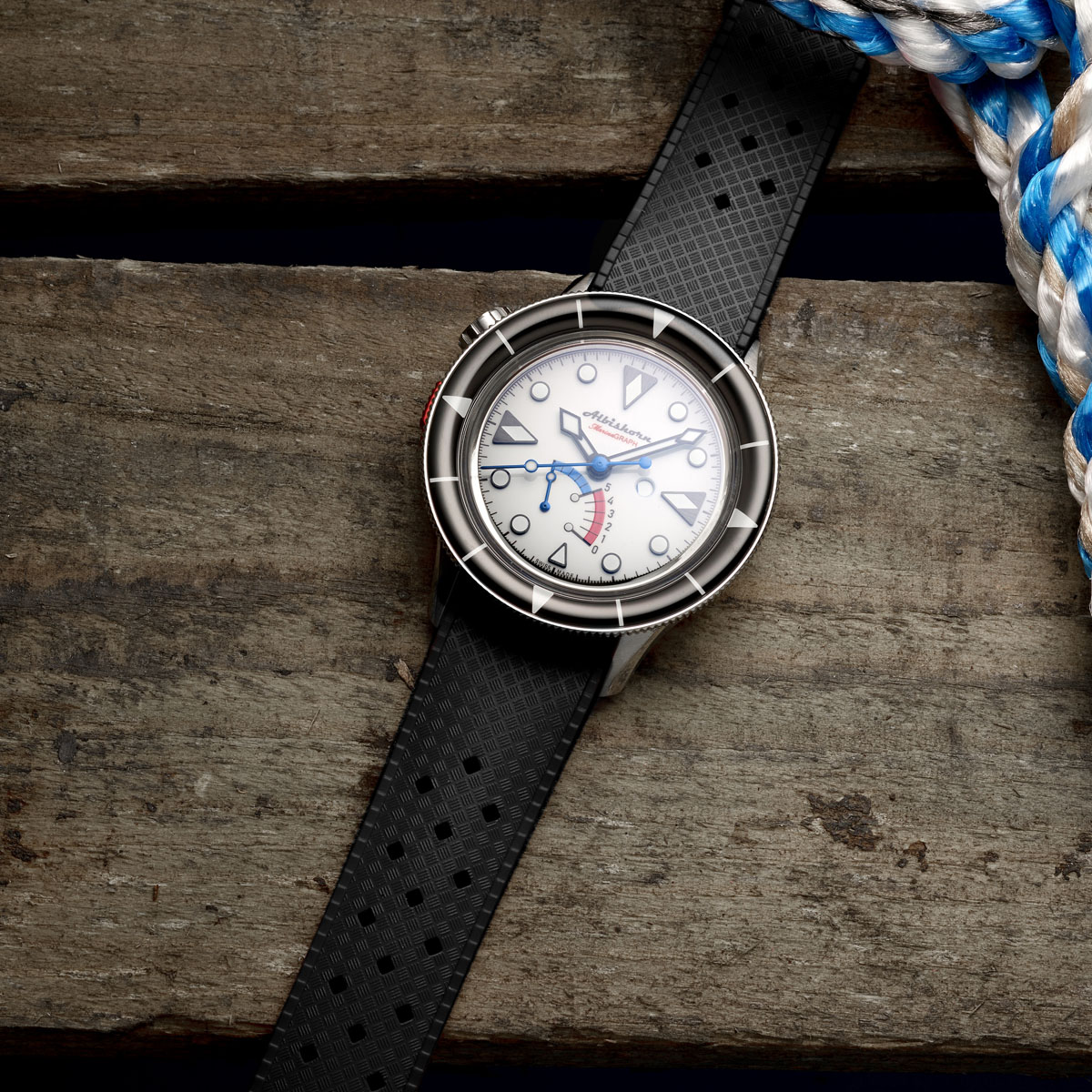
The Marinagraph Classic uses a sunburst black dial, while the Classic Fume uses a white lacquer gradient. Both retain a running indicator at 3 o'clock. The pair therefore changes contrast and atmosphere without changing the information architecture. Black makes the watch visually continuous with its dark bezel, while the white gradient separates the central field more strongly. Those are readings of the documented colours and layout, not claims about one version being objectively clearer.[6]
The running indicator matters because the countdown can sit frozen at zero while chronograph seconds continue. It gives the dial another sign that the mechanism remains active even when the retrograde indication has reached its terminal position. Keeping that element in both editions shows that the new dials are not simply fashion variants. They preserve the display logic and offer two treatments of the same functional structure, with no independent side-by-side wear test yet available.[2] [6]
The ALB01 A, Edition Size and Price
The proprietary ALB01 A is a heavily modified and rotated architecture from the Sellita and Valjoux 7750 family. It is 6.6 mm thick, runs at 4 Hz and provides 64 hours of power reserve. Calling it proprietary is compatible with naming that base: Albishorn's authorship lies in the extensive modification, rotation and integration of the monopusher and retrograde functions, not in claiming a calibre without antecedents. That transparency is essential to understanding the watch's mechanical argument.[7]
Each new dial colour is limited to 99 pieces. The price is CHF 3,950 on rubber or CHF 4,400 on steel, with the bracelet package also including two additional rubber straps, and sales opened on August 14. These are time-sensitive launch terms rather than evidence of lasting availability. They establish the commercial frame around the mechanism: two small editions, two delivery configurations and a clear price difference. The sources do not provide independent chronometric results or long-term ownership evidence to complete the value assessment.[8]
The Dial Brief view
For collectors, the Marinagraph earns attention through the link between story and mechanism. The invented history is openly invented, while the countdown, destro control layout and rotated calibre give it functional substance. The Classic and Classic Fume do not need to create a new complication; their role is to clarify the existing one. The unresolved questions concern real-world operation, finishing, accuracy and whether either dial proves more legible in use.
What we know, and what remains unconfirmed
The patented countdown behaviour and movement architecture are manufacturer claims repeated by launch coverage. The sources do not provide independent chronometric testing, long-term ownership evidence or a hands-on comparison between the two new dials.