Beaubleu Proves Circular Hands Can Support More Than One Watch Family
Beaubleu's circular hands are more than a repeated logo because the Parisian independent changes the cases, movements and dial structures around them. A five-model view shows where orbiting forms support a distinct reading gesture and where the signature risks becoming decoration.
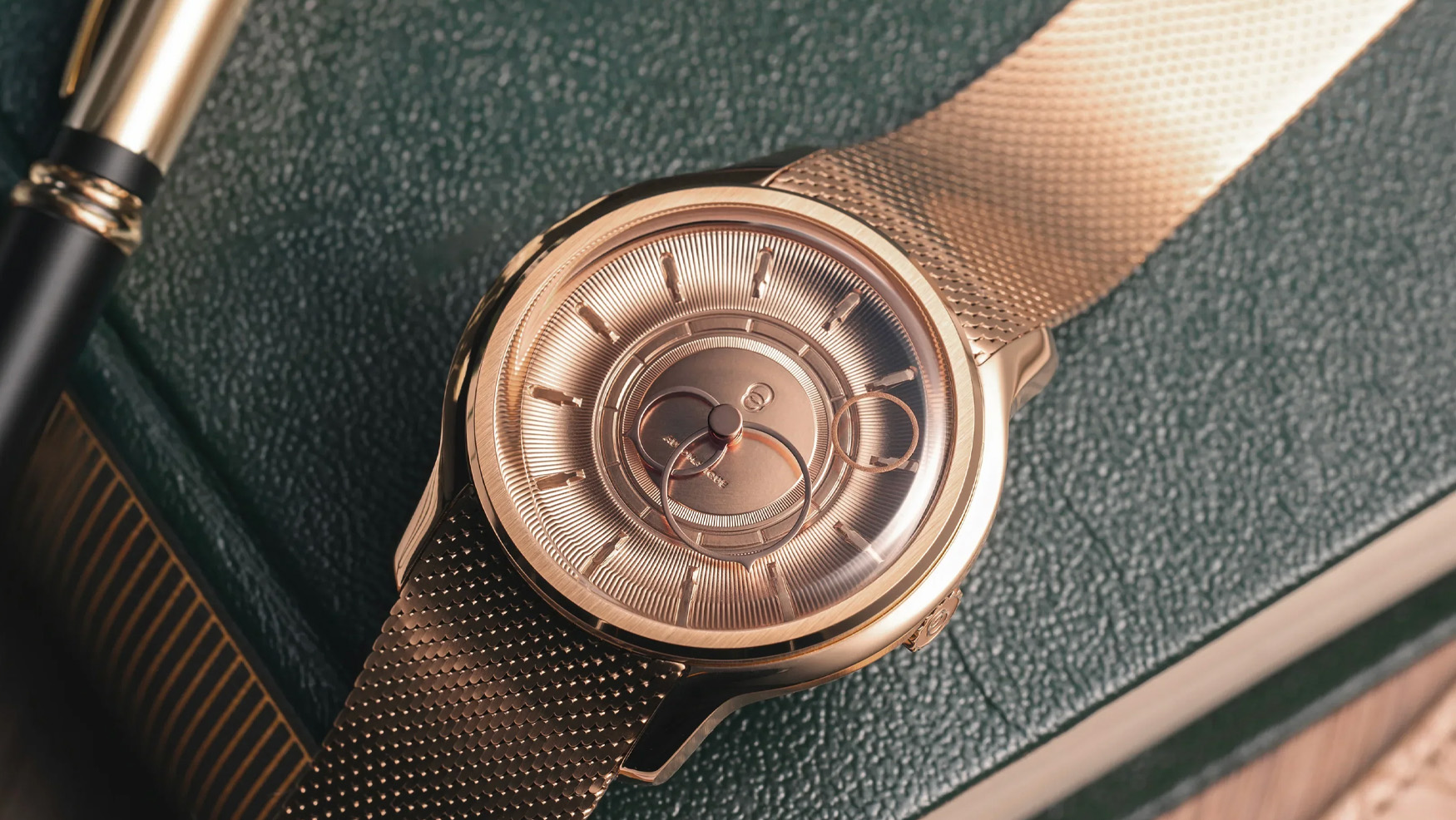
In brief. Beaubleu’s circular hands work as a design system because the brand changes the case, dial architecture and movement around them; the strongest models treat circles as a way of reading time, not merely as decorative signatures.[1] [2] [3] [4] [5] [6] [7] [8]
How Circular Hands Change the Reading Gesture
Beaubleu was founded by Nicolas Ducoudert as an independent Parisian watch brand. The Seconde Française 19.24 uses a peripheral circular seconds indication and a hidden crown.[1] [6]
Nicolas Ducoudert founded Beaubleu around a recognisable alternative to conventional hands. The circular hour and minute forms still indicate against fixed scales, but their moving arcs make negative space part of the display. Reading time becomes an act of locating the relevant point on each circle rather than following two straight pointers from the central pinion.[1] [6]
That gesture can feel intuitive after use, but the sources do not measure learning time or reading speed. The Seconde Française 19.24 extends the concept with a peripheral circular seconds indication and a hidden crown, showing that circles can organise both display and case interaction. Collectors should still try the system rather than assume familiarity from photographs.[1] [6]
Round, Lugless and Shaped Cases
La Pièce No. 2 uses a 39 mm rose-gold-tone steel case and a France Ébauches automatic calibre with 46 hours of reserve. The surveyed models combine circular hands with round, semi-octagonal and compact rectangular case geometries.[2] [7]
The survey prevents the hands from being mistaken for a single-watch trick. Round cases coexist with the 30 by 39 mm lugless Ecce Figura, only 8.6 mm thick, while semi-octagonal and compact rectangular forms alter how the circles meet their boundaries. The same hand language can feel expansive in one case and tightly framed in another.[2] [7]
Scale matters as much as outline. A 39 mm round watch offers symmetry around the orbiting hands, while shaped cases introduce corners and straight edges that make the circles look more graphic. No geometry is automatically superior. The system earns credibility because the brand adjusts surrounding architecture instead of placing identical dials into unrelated shells.[2] [7]
French and Japanese Movements Across the Range
The Ecce Figura uses a 30 mm by 39 mm lugless case that is 8.6 mm thick. The Ecce Vesperal measures 39 mm by 9.5 mm and uses a Miyota 9015 automatic calibre.[3] [4]
La Pièce No. 2 uses a 39 mm rose-gold-tone steel case and a France Ébauches automatic calibre with 46 hours of reserve. The choice connects a Parisian design identity to a French movement source, making origin part of the proposition rather than an invisible technical detail.[3] [4]
The Ecce Vesperal takes a different route with a Miyota 9015 inside a 39 mm by 9.5 mm case. A Japanese supplier calibre can support a thinner or differently priced watch without weakening the circular display itself. The range is therefore defined more consistently by reading architecture than by one movement nationality, although service and accuracy evidence are not compared.[3] [4]
When a Signature Becomes a System
The Ecce Vesperal measures 39 mm by 9.5 mm and uses a Miyota 9015 automatic calibre. La Pièce No. 1 Champagne is limited to 888 pieces and specifies accuracy of minus 9 to plus 9 seconds per day.[4] [5]
A repeated shape becomes a system when it solves different display problems. On La Pièce No. 1 Champagne, the circles sit within a limited 888-piece watch specified to minus 9 to plus 9 seconds per day. On the Ecce models, case geometry changes their visual tension. On Seconde Française, a peripheral seconds indication expands the motif beyond hours and minutes.[4] [5]
The risk is that recognisability becomes an end in itself. Circular hands may attract attention before they improve comprehension, and the sources do not independently test alignment or long-term ease of reading. Beaubleu's strongest answer is variety around the signature: the cases and indications change enough that each model can be judged as a complete composition.[4] [5]
Why the Cross-Collection View Matters Now
The surveyed models combine circular hands with round, semi-octagonal and compact rectangular case geometries. The July 28 guide resurfaced now provides a cross-collection framework rather than announcing a new release.[7] [8]
The July 28 guide is not a current launch. Its value now is comparative, assembling round, semi-octagonal and compact rectangular watches in one design map. That makes it a recent resurfaced read rather than fresh product news, and the date should stay attached to the guide so readers do not infer a new release cycle.[7] [8]
A cross-collection view helps buyers start with architecture. They can choose case shape, scale and movement, then decide whether the circular display strengthens that package. The sources remain partly transactional and do not provide independent accuracy, water-resistance, service or hand-alignment testing. The guide clarifies design relationships, not long-term ownership quality.[7] [8]
The Dial Brief view
Beaubleu has built a genuine design system because its circles do not stand alone. Round, lugless, semi-octagonal and rectangular cases change the visual field; France Ébauches and Miyota movements support different mechanical and price propositions; and the peripheral seconds display shows how the idea can expand. The system still requires a practical test. Circular hands may take time to learn, and the sources offer no independent comparison of reading speed, alignment, accuracy, service or water resistance. Collectors should use the resurfaced guide to choose architecture first, then decide whether the orbiting display adds meaning in that specific watch rather than buying the signature in isolation.
What we know, and what remains unconfirmed
The guide is partly transactional and does not independently test accuracy, long-term hand alignment, service support, water resistance or ease of reading across all five models.