Anders & Co Moves Stone Dials From Dress Watches to a Compact Chronograph
The revised Anders & Co AC1 carries the Swedish brand's natural-stone identity into a 38 mm chronograph. Five dial materials, quieter case revisions and a Seiko VK64 mecaquartz calibre create a dressier sports format without pushing the collection beyond its accessible premise.
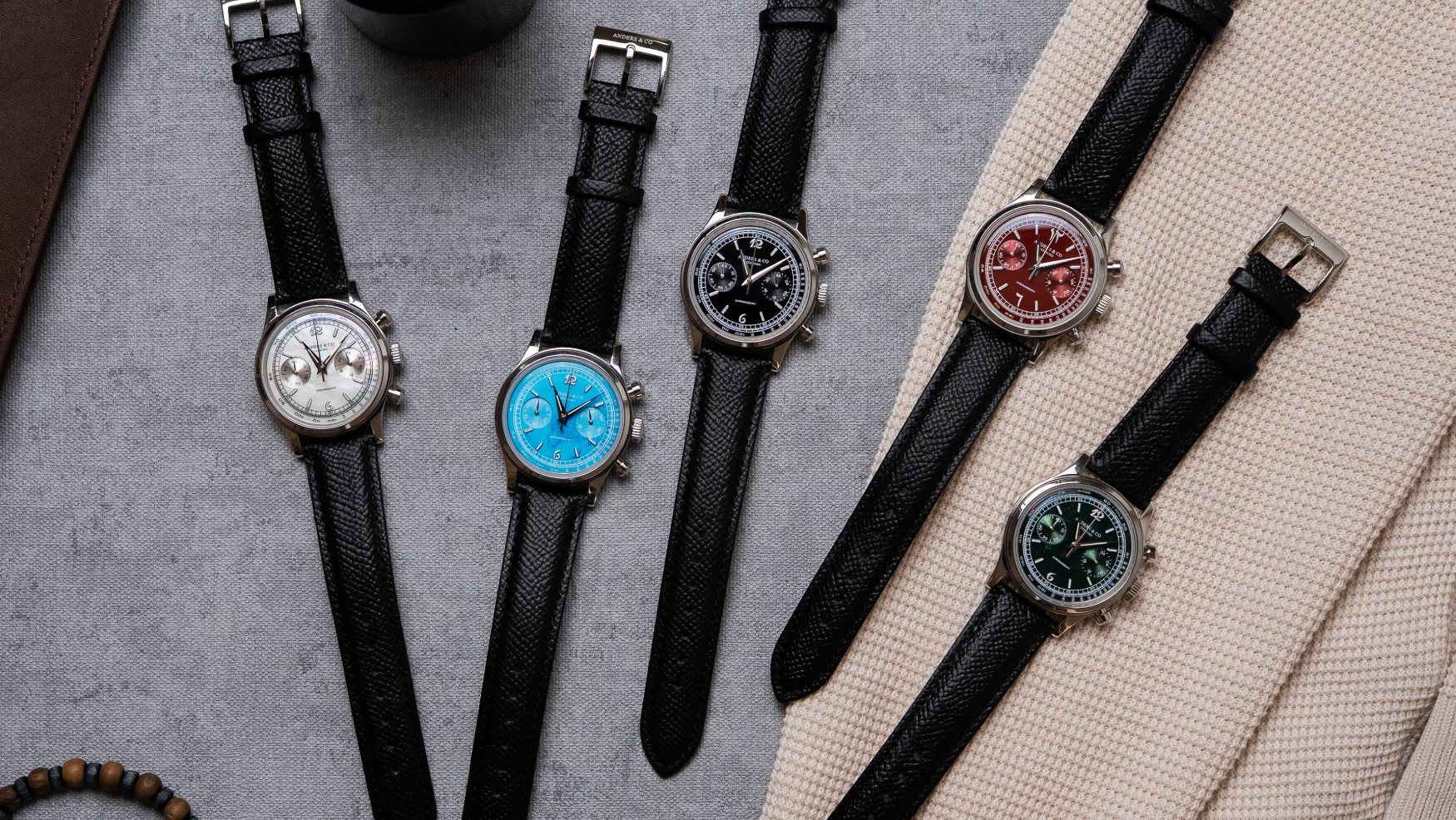
In brief. The revised AC1 is more than a dial swap: Anders & Co uses five stones, sharper hands and quieter case revisions to move its established dress-watch signature into a compact chronograph, while mecaquartz protects the accessible proposition.[1] [2] [3] [4] [5] [6] [7] [8]
Five Stones, Five Different Dial Behaviours
The collection offers mother-of-pearl, black onyx, red jasper, turquoise and bloodstone dials. Revised lug geometry, finishing, pushers and crown distinguish the new case from the earlier AC1.[1] [6]
Natural material prevents the five references from behaving like simple colour variants. Mother-of-pearl changes with reflected light, onyx offers a comparatively uniform black field, jasper and bloodstone introduce mottled structures, and turquoise brings visible mineral variation. Each cut dial can differ, so photographs establish a family appearance rather than guaranteeing the exact pattern a buyer will receive.[1] [6]
Numerals add another distinction. The red jasper version uses Eastern Arabic forms at 12 and 6, while the others use Breguet numerals. That choice gives jasper a different graphic register without requiring a new case. Collectors should compare numeral treatment as carefully as stone colour, because typography affects identity and legibility once subdials divide the natural surface.[1] [6]
A Dress-Watch Material on a Chronograph
The red jasper version uses Eastern Arabic numerals at 12 and 6, while the other versions use Breguet numerals. Standard versions were listed at SEK 6,900, while the bloodstone version was SEK 7,490.[2] [7]
Stone is often associated with uncluttered dress watches, yet the AC1 must also accommodate two subdials, a tachymeter and applied markers. The revised layout works by preserving broad areas of material between those functional elements. The stone remains the visual field rather than becoming a small decorative insert surrounded by chronograph furniture.[2] [7]
This balance is most convincing when contrast survives the material. Black onyx and pale mother-of-pearl present different reading conditions, while heavily patterned stones can compete with small scales. The sources document the layouts but do not provide timed legibility tests. Buyers should inspect the chosen dial rather than assume that every mineral behaves identically under the same hands and markers.[2] [7]
Small Case Changes With Practical Consequences
The steel case measures 38 mm by 11.1 mm with a 46 mm lug-to-lug span. Water resistance increased from 30 metres to 50 metres in the revised AC1.[3] [4]
The steel case measures 38 mm by 11.1 mm with a 46 mm lug-to-lug span, dimensions that keep a chronograph relatively compact. Revised lug geometry, finishing, pushers and crown distinguish the new housing from the earlier AC1. These are modest changes individually, but together they can alter how the watch sits, catches light and communicates quality.[3] [4]
Increasing water resistance from 30 to 50 metres provides a practical gain without turning the AC1 into a swimming watch. The rating better suits routine exposure while preserving a dress-casual character. No independent pressure result or wrist test is supplied, so the improvement should be recorded as a published specification rather than proof of greater durability in every condition.[3] [4]
What the VK64 Adds and Omits
Water resistance increased from 30 metres to 50 metres in the revised AC1. The Seiko VK64 mecaquartz calibre provides chronograph timing without a running-seconds display.[4] [5]
The Seiko VK64 combines quartz timekeeping with a mechanically actuated chronograph module. It gives the pushers and central timing hand a more tactile response than a basic all-quartz display while keeping cost and thickness under control. This supports the accessible proposition and lets dial material receive more of the budget and attention.[4] [5]
The omitted running-seconds display is the most important functional caveat. At rest, there is no continuously moving seconds indication to show that the watch is operating, while the subdials are reserved for timing functions. Some collectors will appreciate the calmer face; others may miss visible motion. The choice is architectural, not an undisclosed defect.[4] [5]
A Material Signature Moving Across Collections
Standard versions were listed at SEK 6,900, while the bloodstone version was SEK 7,490. The earlier AC2 Volcán established Anders & Co as a Swedish brand using multiple natural stones at an accessible price.[7] [8]
Standard versions were listed at SEK 6,900 and bloodstone at SEK 7,490. That modest premium acknowledges a material difference without reorganising the collection around scarcity. Pricing also preserves continuity with the earlier AC2 Volcán, which established the brand's use of multiple natural stones in an accessible Swedish watch proposition.[7] [8]
The format change tests whether a signature can travel. In the AC2, stone could dominate a dress-watch face; in the AC1, it must share space with timing information and pushers. The identity survives when material remains legible and the chronograph feels purposefully arranged. Long-term fracture resistance, stone provenance, production quantities and measured movement accuracy remain undocumented.[7] [8]
The Dial Brief view
The revised AC1 succeeds as a translation of an existing material language, not merely as five dial swaps. Its compact case, reworked controls and improved 50-metre rating give the chronograph a clearer practical frame, while the VK64 preserves price and a satisfying timing action. The choice between mother-of-pearl, onyx, jasper, turquoise and bloodstone should be made from the actual dial and numeral treatment because natural variation and contrast differ. Published prices keep the collection accessible, but the sources do not establish stone provenance, fracture resistance, production totals, battery life or measured accuracy. The strongest purchase reason is coherent material identity at a controlled price.
What we know, and what remains unconfirmed
The sources do not provide long-term tests of dial fracture resistance, measured movement accuracy, battery-life figures, production quantities or independent manufacturing provenance for the stones.