Selten Turns a Dim Sum Memory Into 3,500 Hand-Cut Dial Lines
The Selten Yum Cha translates a Hong Kong family ritual into a silver dial cut with roughly 3,500 lines, then seals that geometry beneath transparent Grand Feu enamel. The 38 mm, 100-piece watch is less a printed cultural reference than a compact record of labour, material and memory.
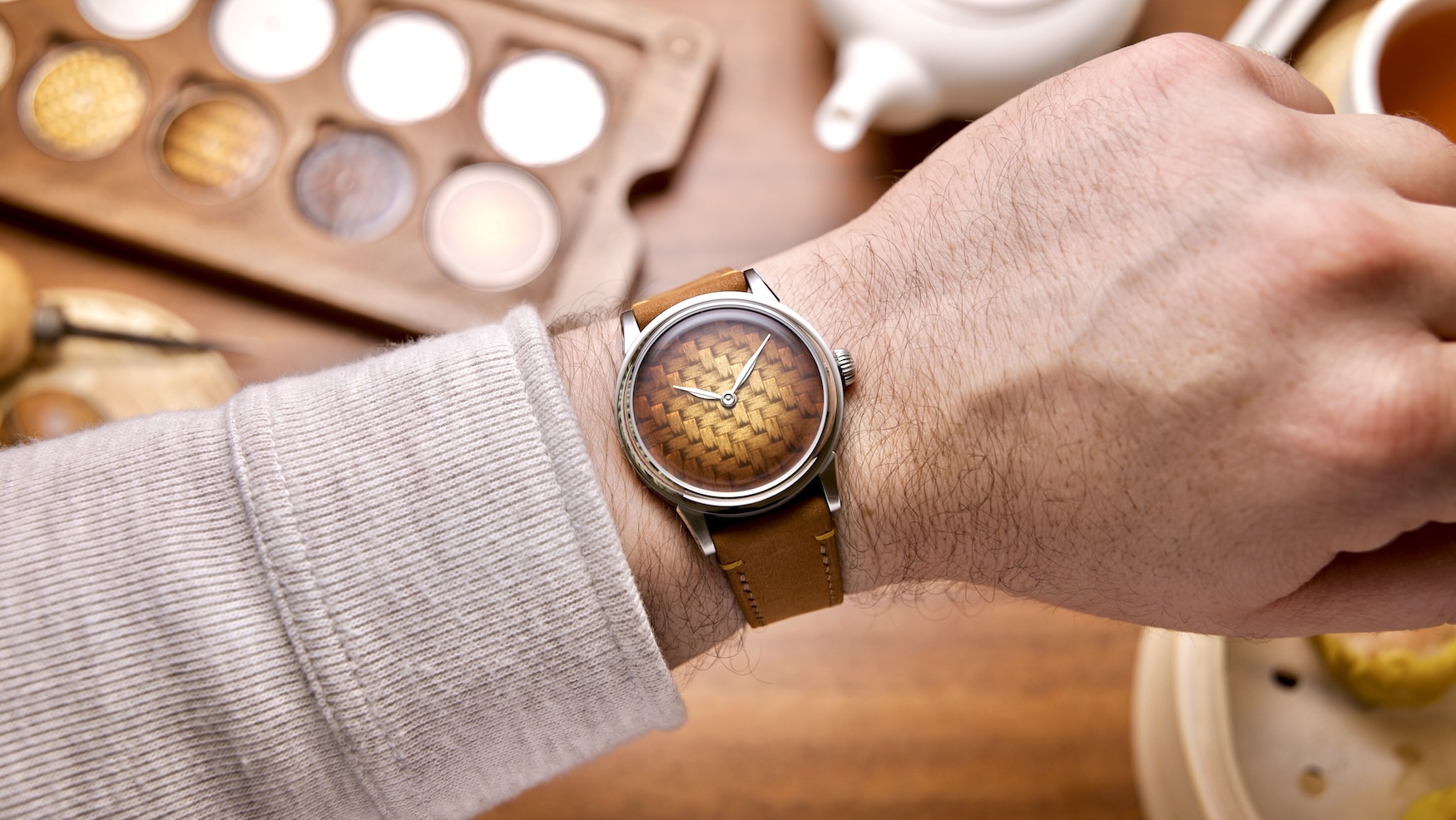
In brief. The Yum Cha succeeds because its cultural reference is built through labour and material rather than branding: the bamboo-steamer pattern requires thousands of hand cuts beneath transparent enamel, while the compact case and familiar calibre keep attention on the dial.[1] [2] [3] [4] [5] [6] [7] [8]
Yum Cha as a Specific Hong Kong Memory
The dial starts as a silver disc divided into about 80 rectangles, each filled with more than 40 hand-cut lines. Jackie Ho framed the watch as a tribute to childhood yum cha meals with his grandparents in Hong Kong.[1] [6]
The reference stays specific because it begins with a person and a repeated family practice. Jackie Ho connects the watch to childhood meals with his grandparents, while the mapped weave evokes the bamboo steamers used during yum cha. The object is not asked to represent all of Hong Kong. It carries one memory through a pattern that can be explained and inspected.[1] [6]
That distinction protects the design from becoming a decorative shorthand. A cultural motif gains weight when its construction follows the story, and here repetition is central to both. Many small lines build a woven surface in the same way that recurring family meals build a memory. The claim is personal and material, not a broad statement about tradition.[1] [6]
How 3,500 Hand Cuts Build the Pattern
Engraving, repeated 800°C enamel firings and polishing require about 16.5 hours for each surviving dial. The caseback illustration marks the Watch Ho & Co(mmunity) third anniversary and allows a personalised table number.[2] [7]
Dividing the silver base into about 80 rectangles creates a controlled map for the engraver. More than 40 bright cuts inside each cell produce the density of a bamboo weave, while small differences reveal that the pattern was made by hand. The dial can therefore appear orderly at normal distance and more irregular under magnification without losing its basic structure.[2] [7]
The cost of failure rises with every completed rectangle. A misplaced cut cannot simply be hidden by adding colour because the transparent upper layer is intended to reveal the metal below. More than 20 prototypes and a rejection rate reported above 40 percent show how development and production losses sit behind the surviving dial, although the sources do not publish yield by production stage.[2] [7]
Why Transparent Enamel Matters
The 38 mm watch is limited to 100 pieces and was offered at USD 4,950. The hand-wound Sellita SW200-2 M Power+ is specified for up to 65 hours of reserve and adjustment to five positions.[3] [4]
Transparent enamel matters because it preserves access to the engraving instead of covering it. Repeated firings at 800 degrees Celsius fuse the glassy layer while polishing restores a clear surface. Light must travel through that layer, meet the bright-cut silver and return through the enamel, producing depth that a printed bamboo pattern could not create in the same way.[3] [4]
The reported 16.5 hours apply to each surviving dial across engraving, firing and polishing. That number is useful as a measure of labour, but it is not a complete cost breakdown. It does not tell us how rejected pieces are allocated, how long preparation takes or whether every artisan works at the same pace. The verified point is the sequence and its demanding yield.[3] [4]
A Compact Case Around Familiar Mechanics
The hand-wound Sellita SW200-2 M Power+ is specified for up to 65 hours of reserve and adjustment to five positions. The case is 9.95 mm thick including the sapphire crystal and is rated to 5 ATM.[4] [5]
At 38 mm across and 9.95 mm thick including the sapphire crystal, the case gives the dial a restrained frame. A 5 ATM rating supports ordinary careful wear rather than aquatic use. These proportions keep the cultural and craft argument on the face of the watch instead of competing with an oversized case or a conspicuous external complication.[4] [5]
The hand-wound Sellita SW200-2 M Power+ is a familiar foundation, specified for up to 65 hours of reserve and adjustment in five positions. Manual winding adds a recurring interaction without suggesting an exclusive calibre. Collectors are therefore paying for the dial, edition and collaboration more than for mechanical novelty, a division of value the watch presents relatively clearly.[4] [5]
What the 100-Piece Edition Asks of Collectors
The caseback illustration marks the Watch Ho & Co(mmunity) third anniversary and allows a personalised table number. The dial development involved more than 20 prototypes and a reported rejection rate above 40%.[7] [8]
The 100-piece limit and USD 4,950 offer place the watch above Selten's more familiar accessible territory. Personalising the caseback table number makes the commemorative layer individual, while the third-anniversary illustration anchors the collaboration in Watch Ho & Co(mmunity). Those details extend the meal narrative without changing the central craft proposition on the dial.[7] [8]
Value depends on whether the buyer credits visible work and controlled production losses. The cut count, firing sequence, prototype history and rejection rate provide unusually concrete evidence for that assessment. They do not answer questions about delivery timing, long-term enamel durability, service cost or rate performance. A collector should treat those as open ownership questions, not gaps to be filled with assumptions.[7] [8]
The Dial Brief view
The Yum Cha is convincing because its reference is inseparable from its method. Jackie Ho's family memory becomes a bamboo-weave map, thousands of cuts give that map physical depth, and transparent enamel keeps the engraving visible rather than replacing it with colour. The compact case and known Sellita calibre wisely avoid competing with the dial. At USD 4,950, however, the purchase case rests heavily on craft evidence and personal resonance. The reported hours, prototypes and rejection rate support that case, but they do not establish delivery timing, service cost, long-term enamel durability or independently measured performance. Those limits should remain part of the decision.
What we know, and what remains unconfirmed
The sources do not provide independent timing measurements, long-term enamel durability evidence, service pricing or a completed-delivery timetable for all 100 pieces.