Papar Gives the Dive Watch a Rotating Colour System
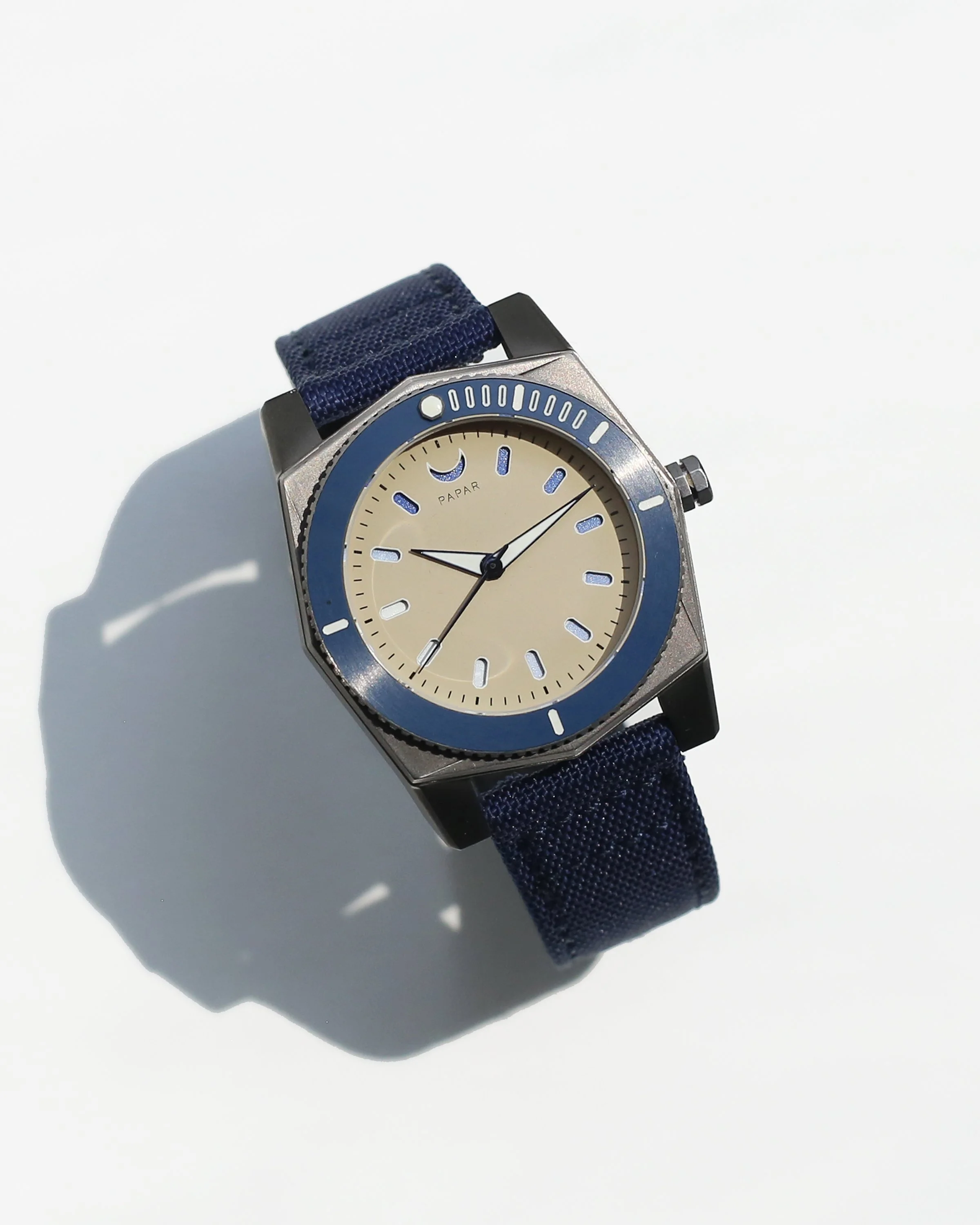
The Papar Cenote Diver changes the colour visible through its hour markers by rotating a lower plate beneath a sandwich dial. Around that display sits a 40 mm grade 2 titanium case, a conventional Miyota 9015 and a 200-metre dive specification.
In brief. Papar’s Cenote is persuasive because its originality is concentrated where collectors can see it: the rotating colour layer and faceted case add identity without turning the underlying dive watch into an experimental ownership risk.[1] [2] [3] [4] [5] [6] [7] [8]
From the Anillo GMT to a Recognisable Papar Language
Papar was founded in Mexico by Josh and Emily and now operates from the Berkshire Mountains in Massachusetts. That cross-border history gives useful context to the brand, but authorship is more clearly visible in the angular, faceted case language that carries from its earlier work into the Cenote.[1]
The Cenote uses a grade 2 titanium case measuring 40 mm across, 47 mm from lug to lug and 10.9 mm thick. These disciplined dimensions keep the geometric design from becoming oversized. The case is therefore expressive through surfaces and angles rather than sheer volume.[1] [2]
A Titanium Dive Case Without Visual Neutrality
On its sailcloth strap and titanium buckle, the watch has a stated weight of 60 grams. Low mass is a practical consequence of the titanium construction, while the faceted form prevents the material from reading as visually anonymous. Weight remains a maker specification, not an independently repeated measurement in the cited review.[2] [3]
The unidirectional bezel uses a lumed ceramic insert and the case is rated to 200 metres of water resistance. These are conventional dive-watch tools, which is useful because they give the unusual dial a stable functional frame. Independent pressure and lume-duration tests are not available in the cited material.[3] [4]
The Colour Layer That Moves Through the Day
A lower plate rotates beneath the sandwich dial and changes the colour visible through the hour-marker apertures. The colour is therefore produced by relative movement between layers, not by an electronic display or a fixed gradient. The effect gives time a slow visual consequence without replacing the normal hands.[5]
The natural titanium version combines a beige lume dial with a blue ceramic bezel. A coated alternative uses rose-gold PVD with black ceramic. Both place the moving colour system inside a clearly defined palette, so the display remains part of the overall design rather than an isolated novelty.[5] [6]
The rotating layer changes what appears in the apertures without changing the basic reading order of hands, markers and bezel. That restraint matters in a diver because the unusual element remains subordinate to the time display. The sources describe the colour movement, but not a timing or control function assigned to the lower plate.[5]
A Conventional Miyota at the Centre
The automatic Miyota 9015 runs at 28,800 vibrations per hour and has a stated 42-hour power reserve. It is a known movement family beneath a less conventional display, which can reduce uncertainty around routine calibre service compared with a proprietary mechanical base.[7]
A familiar movement does not automatically make the whole watch simple to maintain. The rotating lower plate and its interface with the display remain specific to Papar. The sources identify the visual behaviour but do not publish a long-term reliability test or a detailed service procedure for that system.[5] [7]
What the First 200 Watches Ask of Buyers
The initial run is limited to 100 numbered watches per colour at USD 995. Across two colour treatments, that creates 200 first-run examples. The price places the Cenote’s originality in a relatively accessible band, though present stock can differ from the allocation described at launch.[8] [6]
Buyers have solid evidence for dimensions, material, movement and stated water resistance. They have less evidence for rotating-disc durability, lume duration and real pressure performance. The sensible contract is to value the visible design and conventional movement while requesting current availability, warranty coverage and service terms for the proprietary display parts.[4] [8]
The Dial Brief view
The Cenote concentrates risk intelligently. Its identity comes from case geometry and a moving colour layer, while the automatic movement and core dive hardware remain familiar. That makes the watch easier to understand than a concept in which every subsystem is experimental. Buyers should still ask how the lower disc is driven, adjusted and serviced, because the sources do not provide a reliability history. At USD 995 and 100 numbered examples per colour, the proposition is strong for collectors who value visible authorship, provided availability and after-sales support are confirmed before purchase.
What we know, and what remains unconfirmed
No independent water-resistance, lume-duration or long-term rotating-disc reliability test is published, and current stock may differ from the initial allocation described by the sources.