Maurice Lacroix Makes Solar Power Part of the Dial Design
The Maurice Lacroix Pontos S Solar collects light through a smoked translucent dial that transmits roughly 20 to 30 percent of incoming light. Three-hand and chronograph versions use different Swiss Ronda solar movements inside a 42 mm sports-watch case.
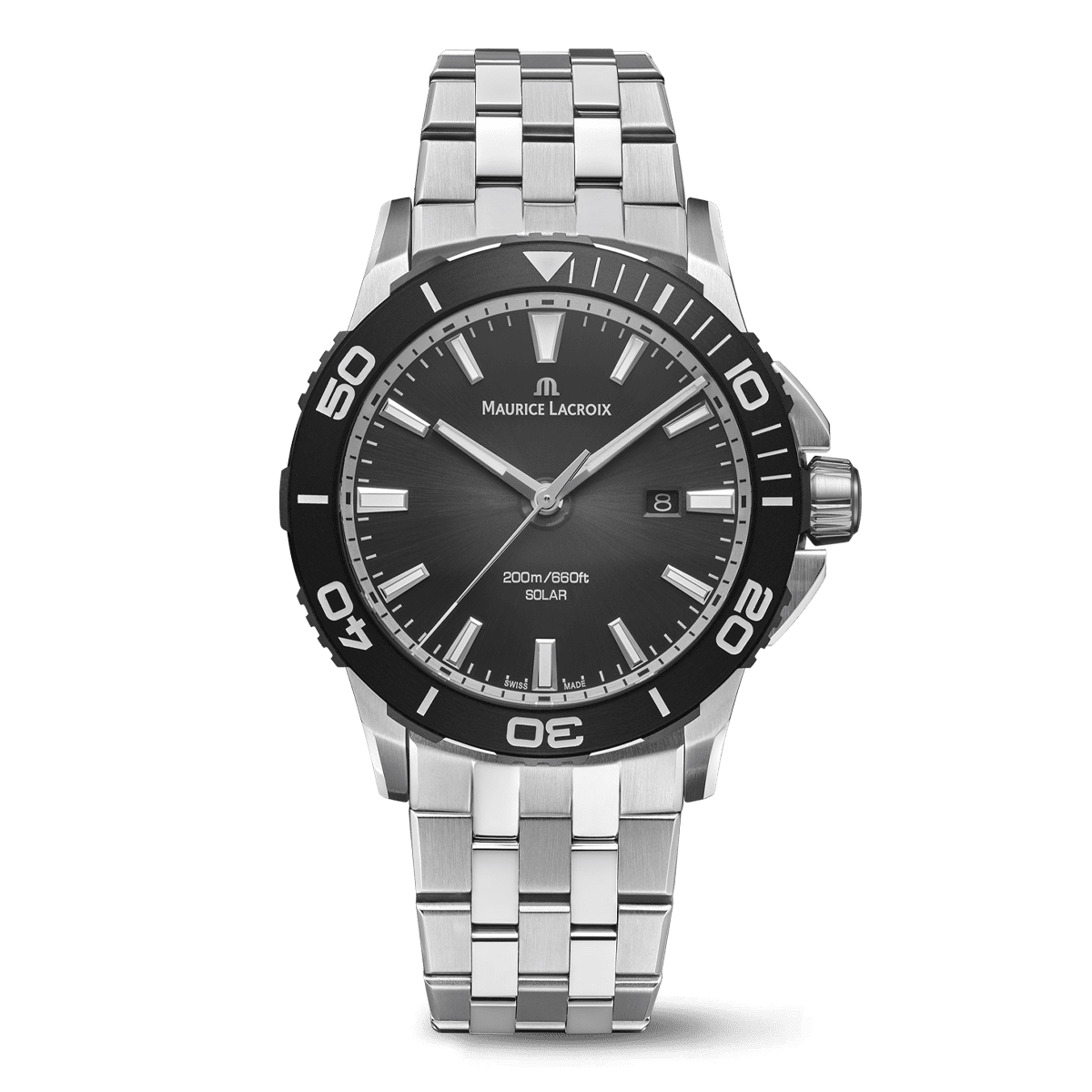
In brief. The Pontos S Solar is most interesting not as a maintenance-free claim but as a material problem: the dial must transmit enough light while preserving contrast, lume and the visual weight expected of the Pontos line.[1] [2] [3] [4] [5] [6] [7] [8]
Why Solar Is a Structural Change for Pontos
The Pontos S Solar is the first Pontos range to use Swiss-made solar quartz movements. That change affects more than the calibre because light must reach the energy system through the dial. The familiar sports-watch face therefore becomes part of the power architecture.[1]
The three-hand model uses the Ronda 215 Solar, while the chronograph uses the Ronda 2040.D Solar. Separating the movement families matters because their functions and stated autonomy differ. Solar describes the shared charging principle, not a single interchangeable mechanism across every reference.[1] [2]
The Dial Has to Transmit and Communicate
The smoked translucent dial transmits roughly 20 to 30 percent of incoming light to the movement. It must allow energy capture while retaining enough colour and contrast to look like a Pontos. This is the central material compromise, and the cited percentage makes it more concrete than a generic solar label.[4]
Blue and green Super-LumiNova colours distinguish minute and bezel indications from the hours and other markings. The two-colour scheme helps the dial communicate after dark even though translucency governs its daylight construction. No independent test is supplied for lume duration or charging performance under different light conditions.[4] [5]
Transmitting only a portion of incoming light explains why dial colour and energy capture cannot be separated. More transparency might favour charging while weakening the visual density expected of a sports watch; less could preserve appearance while reducing available light. The reported range records the chosen balance, not an independently established optimum.[4]
What the Charge Claims Do and Do Not Mean
WATCHNAVI reports stated full-charge operating periods of about eight months for the three-hand watch and five months for the chronograph. The difference reinforces that the two movement families should be assessed separately. It also gives owners a practical reason to consider how often each watch will see light.[3] [2]
A long operating period after full charge does not establish battery life, lifetime accuracy or freedom from service. Solar quartz still depends on an energy-storage system, seals and electronic components. The sources provide autonomy figures but no independent charge-cycle test or long-term maintenance schedule beyond the movement identification.[3] [2]
Pontos Hardware Remains Intact
The official PT1008 page specifies a 42 mm steel case, 13 mm thickness and 20-atmosphere water resistance. Those dimensions keep the solar version within a substantial modern sports-watch format. One conflicting caption in the secondary report should not replace the repeated official 20-atmosphere specification.[6]
A unidirectional bezel with an aluminium insert, screw-down protected crown and tool-free Easychange straps or bracelets preserve familiar Pontos hardware. These elements make the energy transition less visually disruptive. The cited sources still do not provide an independent pressure test or a comparative assessment of strap security.[6] [7]
A Broad Range with Uneven Evidence
Japanese list prices at publication ranged from JPY 231,000 to JPY 357,000 across the three-hand and chronograph configurations. The breadth reflects function and fit choices rather than one reference. Local pricing and availability can change, so these figures belong to the publication date and market cited.[8]
Evidence is strongest for movement identity, case specification and dial transmission. It is weaker for measured accuracy, charge cycles and water resistance under test. The conflicting caption in the report is another reason to privilege the official 20-atmosphere value while clearly stating that it has not been independently verified.[6] [8]
The Dial Brief view
The Pontos S Solar is most useful as a counterpoint to mechanical sports watches. Its energy source is visible in the dial design, yet it keeps the bezel, crown protection and water-resistance language of the established line. Buyers should choose between the simpler three-hand and chronograph by function and stated autonomy, not assume both solar systems behave identically. They should also treat long full-charge figures as operating claims rather than promises of zero maintenance. Independent accuracy, charge-cycle and pressure tests would make the ownership proposition clearer.
What we know, and what remains unconfirmed
The Japanese report and official product page describe specifications but provide no independent charge-cycle, accuracy or water-resistance testing; one caption in the report conflicts with the otherwise repeated 20-atmosphere rating and should not be used without qualification.