Baltic Adds a Date Without Breaking the Aquascaphe’s Balance
Baltic adds a date to the Aquascaphe MK2 without treating the complication as a complete redesign. The window sits at six o’clock on a colour-matched disc, two case sizes remain, and buyers can still choose a true no-date movement. The platform broadens while its visual balance stays recognisable.
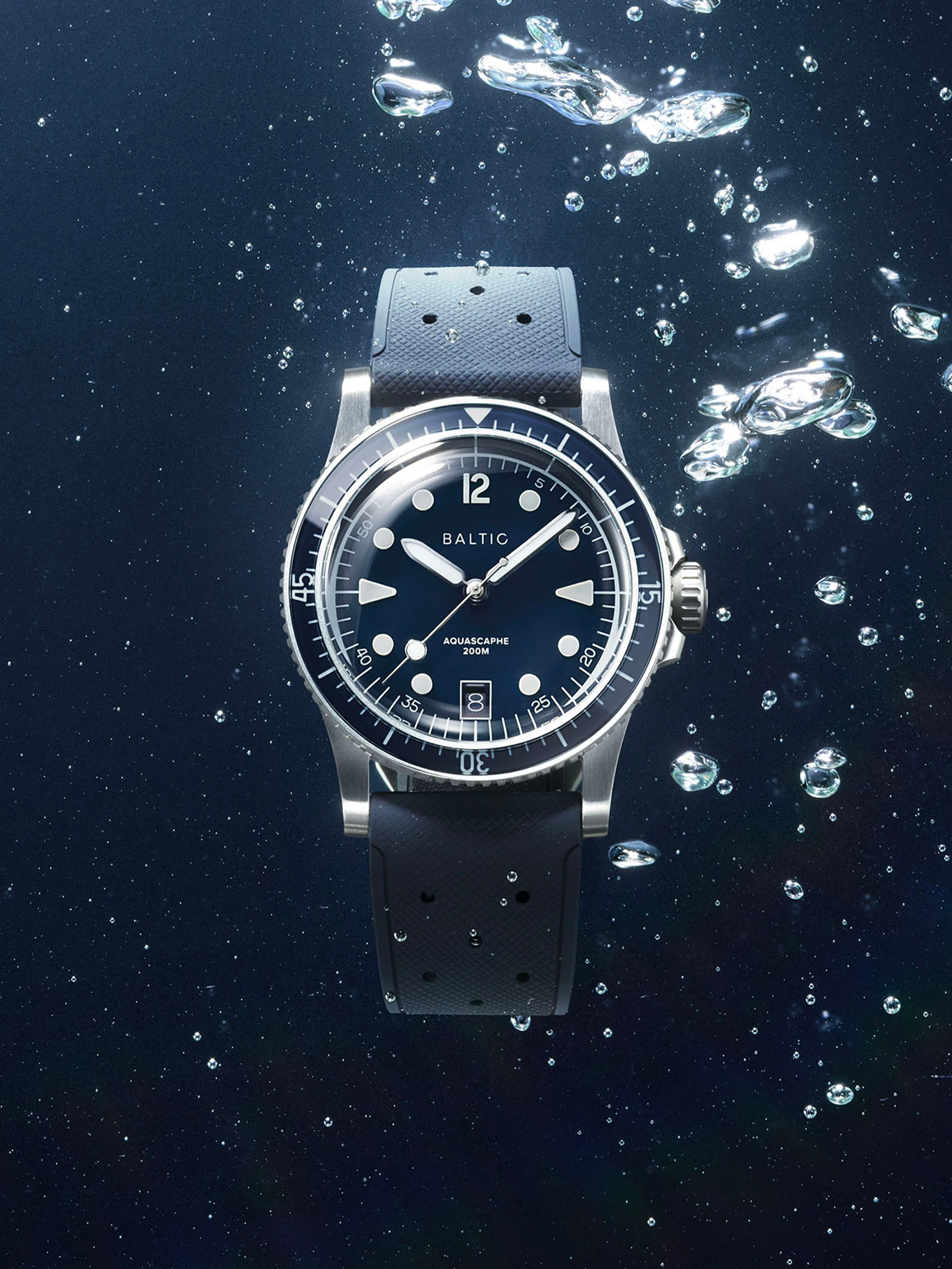
In brief. Baltic treats the date as an extension of the MK2 platform rather than a new aesthetic direction, preserving symmetry through placement and colour while using movement choice to make the complication optional.[1] [2] [3] [4] [5] [6] [7] [8]
The MK2 Platform Before the Date
The Aquascaphe MK2 is offered in 37 mm and 39.5 mm case sizes, with 45 mm and 47 mm lug-to-lug measurements respectively. Both case sizes are 12.9 mm thick including the double-domed sapphire crystal and 10.7 mm without it.[1] [2]
The two-size platform is the foundation for the update. Baltic retains compact 37 mm and larger 39.5 mm choices, with the same stated thickness in both. That continuity lets collectors judge the date as a dial and movement decision rather than as compensation for a newly enlarged case.[1] [2]
For collectors, the relevant task is to separate what the sources document from what still requires experience. Set out the two sizes, case construction and 2025 redesign baseline. The cited material establishes these points, but it does not support broader claims about long-term ownership, measured performance or future market value.[1] [2]
Why Six O’Clock Is the Important Choice
The new date window sits at six o’clock and uses a colour-matched date disc to preserve dial symmetry. Date models use the Miyota 9015, while no-date models use the Miyota 9039 without a ghost crown position.[3] [4]
Six o’clock preserves the vertical axis better than a conventional three o’clock aperture. Matching the disc to the dial further reduces contrast, though that can also make rapid reading less assertive. The design succeeds by accepting a visible complication while controlling how much attention it demands.[3] [4]
For collectors, the relevant task is to separate what the sources document from what still requires experience. Examine symmetry, colour matching and the visible design compromise. The cited material establishes these points, but it does not support broader claims about long-term ownership, measured performance or future market value.[3] [4]
Miyota 9015 or 9039
Both movements run at 28,800 vibrations per hour, offer a 42-hour power reserve and support hacking seconds. The case is rated to 200 metres and uses a screw-down crown plus a 120-click unidirectional bezel with a sapphire insert.[5] [6]
Using separate movements gives each version a mechanically honest crown sequence. The Miyota 9015 supports the date, while the 9039 removes it without leaving an unused setting position. Their shared frequency, reserve and hacking function keep the basic ownership experience close across the range.[5] [6]
For collectors, the relevant task is to separate what the sources document from what still requires experience. Explain the date and no-date movement split, including the absence of a ghost position. The cited material establishes these points, but it does not support broader claims about long-term ownership, measured performance or future market value.[5] [6]
The Dive-Watch Hardware Remains Intact
Applied 0.4 mm Lumicast markers, the bezel scale and the hands use Super-LumiNova BGW9. Prices before tax range from EUR 630 for no-date on rubber to EUR 720 for date on a steel bracelet.[7] [8]
The established dive hardware remains the practical anchor. Two hundred metres of stated water resistance, a screw-down crown and a unidirectional sapphire-insert bezel support the format. Lumicast markers and BGW9 luminous material define the night display, although no independent testing is available here.[7] [8]
For collectors, the relevant task is to separate what the sources document from what still requires experience. Document water resistance, bezel, lume and sapphire components. The cited material establishes these points, but it does not support broader claims about long-term ownership, measured performance or future market value.[7] [8]
A Broader Range Without a Forced Upgrade
The Aquascaphe MK2 is offered in 37 mm and 39.5 mm case sizes, with 45 mm and 47 mm lug-to-lug measurements respectively. Both case sizes are 12.9 mm thick including the double-domed sapphire crystal and 10.7 mm without it.[1] [2]
The new model expands choice instead of replacing the earlier proposition. Case size, date, colour and strap can be combined across a broad price band. That is collector-friendly in principle, but real inventory can narrow the apparent range, so availability still needs to be checked for a specific configuration.[1] [2]
For collectors, the relevant task is to separate what the sources document from what still requires experience. Compare prices, straps, sizes and the continued no-date option. Neither source provides independent water-resistance testing or a hands-on comparison of the date and no-date versions, and real-world availability may vary by colour, size and strap.[1] [2]
The Dial Brief view
The meaningful choice is not simply date versus purity. Buyers should compare how often they use a date, whether the six o’clock window remains legible in their preferred colour, and which case size fits. The dedicated Miyota 9039 means the no-date model avoids a ghost crown position. Prices and straps then provide a second decision layer without forcing the complication on the entire range.
What we know, and what remains unconfirmed
Neither source provides independent water-resistance testing or a hands-on comparison of the date and no-date versions, and real-world availability may vary by colour, size and strap.