Nectere’s Eclipse Makes Affordable Thinness Part of the Design
The Nectere Eclipse is more than an affordable asymmetric dress watch because its 3.2 mm hand-wound movement directly enables an 8.5 mm case. The 100-piece, US$880 release turns accessible Chinese mechanics into a design tool, although an independent hands-on identifies the mesh-bracelet clasp as the clearest compromise.
In brief. The Eclipse is most convincing when its low-cost Chinese hand-wound calibre is read as an enabling component: it keeps an ambitious asymmetric case genuinely thin, even as the bracelet reminds collectors where the sub-US$1,000 compromise lands.[1] [2] [3] [4] [5] [6] [7] [8]
Details from every angle
The Eclipse’s Asymmetric Case Has a Mechanical Reason
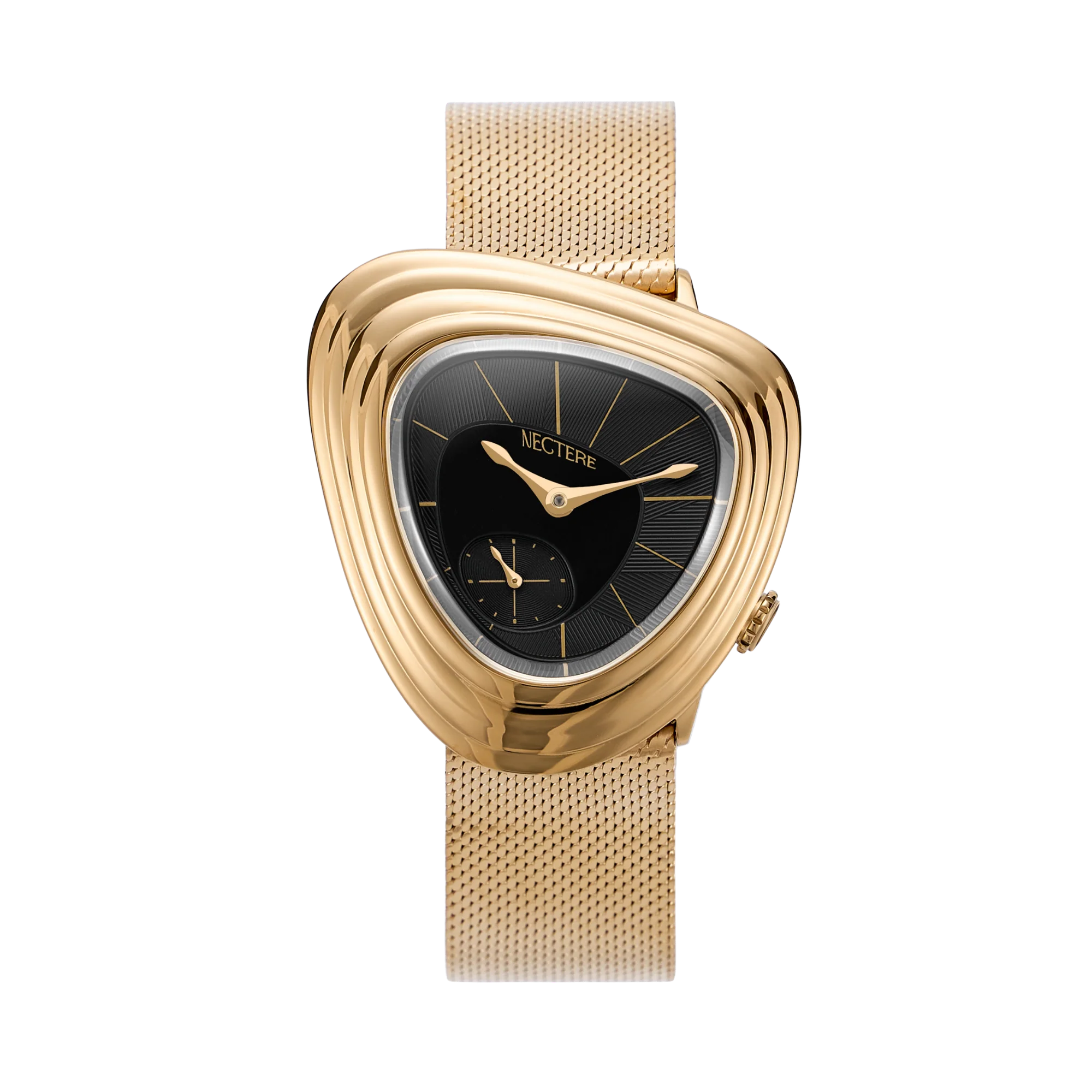
Nectere launched the Eclipse on August 12, 2026, around a case that avoids the easy symmetry of a conventional round dress watch. The stepped, off-centre form and small seconds near 7 o’clock make the celestial reference visible, but the design is not merely a graphic treatment applied to a standard shell. Its gold-PVD stainless-steel case measures 38 mm wide, 40.5 mm from lug to lug and 8.5 mm thick. Those restrained dimensions give the unusual outline a plausible route to the wrist rather than leaving it as a display-case exercise.[1] [3]
The important relationship is between silhouette and construction. A case this visually assertive could easily become bulky if it had to hide a tall automatic movement and rotor. Instead, the thin hand-wound calibre creates room for the stepped architecture while keeping the total height below nine millimetres. That does not make the Eclipse mechanically radical, and the sources do not claim it is. It makes the movement choice coherent: the calibre serves the proportion and lets the asymmetric case remain the main event without turning the watch into an awkwardly thick object.[3] [4]
How the ST-17 Keeps the Watch at 8.5 Millimetres
Inside is a hand-wound Sea-Gull ST-17 that is approximately 3.2 mm thick. It runs at 3 Hz and offers 39 hours of power reserve. None of those numbers competes with modern long-reserve automatics, yet the thinness is the specification that matters most to this design. Manual winding removes the need to stack a full rotor above the movement, and the resulting vertical economy helps explain how Nectere reaches an 8.5 mm total case thickness while retaining a shaped case, a sapphire front crystal and a separate rear viewing aperture.[4] [5]
The crystal choices also show where cost and packaging are being managed. Sapphire covers the dial, the surface most exposed to everyday scratches, while the small rear movement aperture uses K1 mineral glass. That is a selective allocation rather than a claim of uncompromised construction. The 39-hour reserve similarly asks for regular interaction if the watch is worn across several days. In return, the crown and hand-wound format make engagement part of ownership. The independent review specifically praised the winding crown, evidence that the daily ritual was not treated as an incidental requirement.[4] [5] [8]
What the Independent Hands-On Adds
Official imagery establishes the Eclipse’s intended drama, but the hands-on review adds evidence about how the concept is executed. The reviewed configuration combines the black dial and gold-PVD case with a gold-tone mesh bracelet. Nectere also supplies an 18 mm leather strap and a matching gold-PVD buckle, so the watch is not locked into the mesh presentation. The review found the thin construction convincing and praised the winding crown, two observations that support the idea that the movement and case were developed as a usable package rather than as isolated specifications.[6] [8]
The same review locates the main compromise in the mesh-bracelet clasp, which it found awkward to operate. That criticism matters because the bracelet is visually central to the exact gold-and-black configuration shown here. A clasp can be a small component in a specification list and still dominate routine ownership through every adjustment and removal. The supplied leather strap offers an alternative, but it does not erase the limitation of the bracelet as delivered. One review sample cannot establish production-wide consistency, yet it provides a concrete trade-off that official presentation alone would not reveal.[6] [8]
A Young Hong Kong Brand Building Through Suppliers
Nectere was founded in Hong Kong in 2024 by James Wong and Tony Yip. That short history should set the scale of the claim. The Eclipse is not evidence of a vertically integrated manufacture, and neither source presents it that way. It is evidence that a young brand can specify an existing Chinese hand-wound calibre in service of a distinctive case. The supplier relationship is therefore part of the design method: accessible movement production gives the founders a route to unusual proportions without requiring them to build a calibre programme before establishing a visual identity.[7] [4]
Using the ST-17 openly also prevents the case from borrowing prestige through vague movement language. Collectors can see the trade: a known Sea-Gull base with modest reserve and frequency supports an ambitious external form at a price below US$1,000. The meaningful authorship lies in selection, packaging and execution, not in pretending the mechanism is unique to Nectere. That division of labour is common among small brands, but the Eclipse makes it unusually legible because its thinness would be difficult to separate from the calibre. The movement is valuable here chiefly because it enables the design.[2] [4] [7]
Where the Sub-US$1,000 Compromise Appears
The Eclipse is limited to 100 pieces at US$880. At that level, its case shape, 8.5 mm thickness and included second strap form a clearer value argument than movement exclusivity. The ST-17 offers 39 hours of reserve, and the rear aperture uses K1 mineral glass rather than sapphire. Those are visible boundaries, not hidden defects. The harder question is whether buyers accept the awkward mesh clasp on the configuration that gives the watch much of its character. The independent review suggests that the compromise is felt in handling rather than in the central design or winding experience.[2] [4] [5] [8]
For collectors, the strongest reading is neither bargain triumph nor inexpensive imitation. The Eclipse uses a low-cost calibre intelligently and spends its expressive energy on the case. Its limited run defines the launch but does not guarantee scarcity value, and current sell-through was not independently confirmed. The 100-piece format, price and hands-on observations establish a credible first assessment; they do not answer long-term questions about accuracy, plating durability, clasp wear or service. The watch earns attention for joining mechanics and proportion honestly, with its compromises left visible enough to judge.[2] [3] [8]
The Dial Brief view
The Eclipse gives collectors a useful example of movement choice as design infrastructure. Its Sea-Gull calibre is not prestigious in isolation, but its 3.2 mm thickness makes the case’s 8.5 mm profile possible. The review evidence keeps that success grounded by identifying the mesh clasp as a daily-use weakness. At US$880, the case, proportions and transparent trade-offs are more persuasive than any attempt to inflate the calibre’s status.
What we know, and what remains unconfirmed
What we know, and what remains unconfirmed: no long-term accuracy, durability or owner data is available. The hands-on reflects one review sample, current sell-through was not independently confirmed, and the sources do not establish how the gold PVD or mesh clasp will age.