Dominique Renaud Slows the Regulator to Make Every Beat Visible
The Dominique Renaud Pulse 60 makes a slow one-hertz regulator the centre of both its mechanics and its display. A 20mm balance occupies the dial side, beats visibly once per second and works with an unusual high-amplitude architecture whose spectacle is clear even though measured accuracy remains unreported.
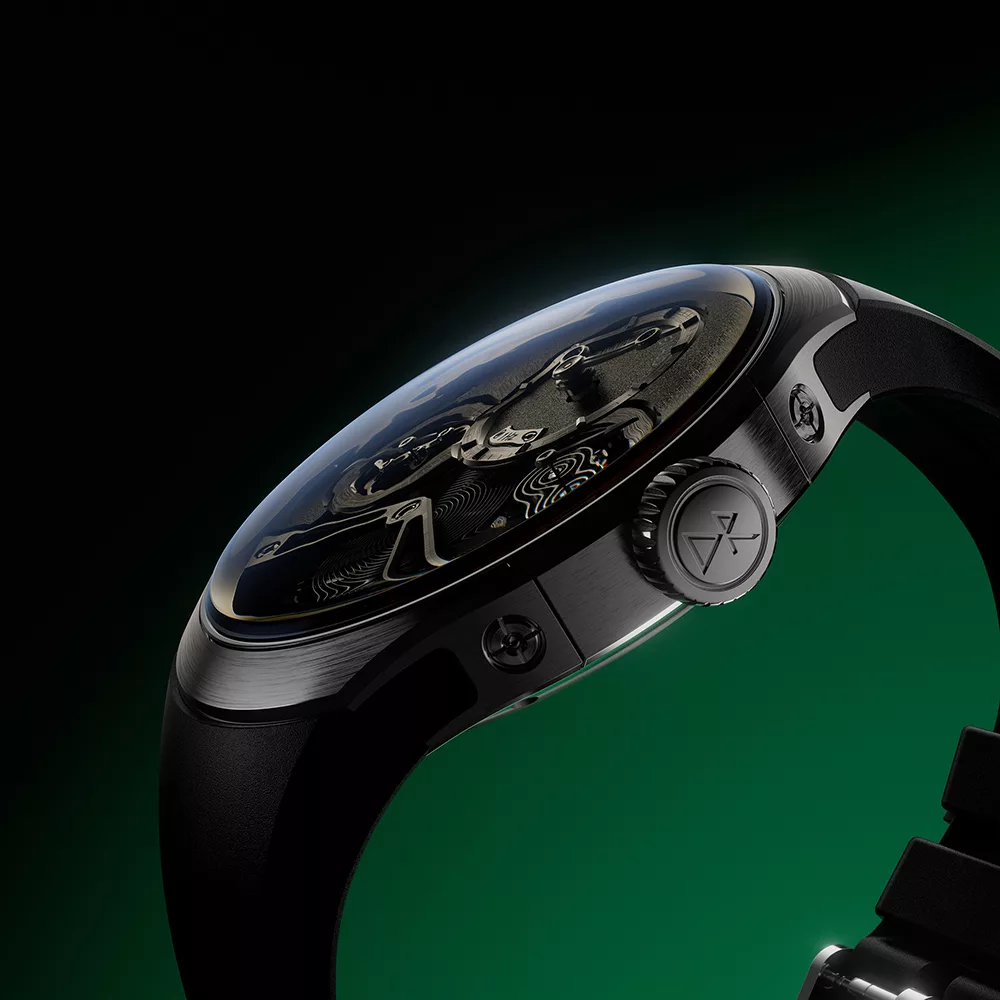
In brief. The Pulse 60 turns low frequency from a historical curiosity into the watch’s visual and mechanical organising principle, while leaving accuracy claims deliberately open.[1] [2] [3] [4] [5] [6] [7] [8]
The High-Frequency Assumption
Dominique Renaud created his eponymous brand in 2026 after co-founding Renaud & Papi in 1986. The Pulse 60 uses the hand-wound BUA2024 calibre at one hertz, or 7,200 vibrations per hour. These documented points define the factual boundary for this part of the story. Read together, they show why the high-frequency assumption is material to the watch rather than a detachable specification or decorative aside.[1] [2]
The one-hertz rate rejects the contemporary habit of treating higher frequency as the default route to stability. It also makes each oscillation legible, turning regulation into the watch’s visible subject. This is the useful collector reading of the evidence: set the conventional 4Hz compromise before introducing Renaud’s counterargument. The conclusion stays within the cited material and does not turn a launch specification or a single review observation into a broader performance claim.[1] [2]
Why Slow Balances Still Matter
Its dial-side balance measures 20mm across. The redesigned regulating organ permits amplitudes beyond 360 degrees, with a stated theoretical maximum of 700 degrees. These documented points define the factual boundary for this part of the story. Read together, they show why why slow balances still matter is material to the watch rather than a detachable specification or decorative aside.[3] [4]
A large balance can carry high inertia, while the stated amplitude moves far beyond the familiar range. That historical logic is informative, but it should not be mistaken for proof that the wristwatch performs like a marine chronometer. This is the useful collector reading of the evidence: connect high inertia to marine-chronometer logic without claiming equivalence. The conclusion stays within the cited material and does not turn a launch specification or a single review observation into a broader performance claim.[3] [4]
Inside the One-Hertz Regulating Organ
The case is 40mm wide and 12mm thick in titanium or pink-gold-and-titanium forms. Hours and minutes sit at twelve, a torque indicator at three, and half-second small seconds at nine. These documented points define the factual boundary for this part of the story. Read together, they show why inside the one-hertz regulating organ is material to the watch rather than a detachable specification or decorative aside.[5] [6]
The case materials and dimensions are built around the regulating organ rather than hiding it. Separate time, torque and seconds indications let the wearer read the consequences of a movement organised around slow, conspicuous impulses. This is the useful collector reading of the evidence: explain size, amplitude, impulses and the redesigned escapement. The conclusion stays within the cited material and does not turn a launch specification or a single review observation into a broader performance claim.[5] [6]
A Case Organised Around the Beat
Prices are CHF 49,000 in titanium and CHF 59,000 in pink gold and titanium, excluding taxes. No official accuracy figure was supplied and the hands-on source did not measure rate performance. These documented points define the factual boundary for this part of the story. Read together, they show why a case organised around the beat is material to the watch rather than a detachable specification or decorative aside.[7] [8]
The price positions this as serious independent horology, but the source packet does not include measured rate results. The visible originality is documented; accuracy and resilience under real wear remain separate questions. This is the useful collector reading of the evidence: map the case, balance, time display, torque and seconds indications. The conclusion stays within the cited material and does not turn a launch specification or a single review observation into a broader performance claim.[7] [8]
The Claims the Pulse 60 Does Not Make
Dominique Renaud created his eponymous brand in 2026 after co-founding Renaud & Papi in 1986. The Pulse 60 uses the hand-wound BUA2024 calibre at one hertz, or 7,200 vibrations per hour. These documented points define the factual boundary for this part of the story. Read together, they show why the claims the pulse 60 does not make is material to the watch rather than a detachable specification or decorative aside.[1] [2]
That absence of a rate claim is editorially important. It keeps the assessment focused on architecture and experience while preventing an inventive mechanism from being translated into unsupported claims of superior precision. This is the useful collector reading of the evidence: close on price, accuracy, shock and testing limits. The conclusion stays within the cited material and does not turn a launch specification or a single review observation into a broader performance claim.[1] [2]
The Dial Brief view
The Pulse 60 is compelling because its visual language follows its regulating idea. The oversized balance, separated indications and torque display all direct attention toward energy delivery and beat. That coherence does not prove better timekeeping, shock resistance or long-term reliability. A collector considering the substantial price should therefore distinguish the originality of the mechanism from performance that has not been quantified, and treat the open questions as part of the purchase decision.
What we know, and what remains unconfirmed
The brand does not publish a rate specification, and Monochrome did not perform an accuracy test; shock behaviour and long-term wear therefore remain theoretical rather than independently established.